Friday, January 11, 2013

I-58 Otsu-type Japanese submarine


The I-58 was laid down on December 26, 1942 at the Yokusuka Naval Arsenal and launched on June 30, 1943. She was the third vessel of her type, and her primary task was reconnaissance. The I-58 was initially equipped with a Type 0 Small Reconnaissance Seaplane (Yokusuka E14Y "Glen") and a launch rail, and she was completed on September 7, 1944 after being modified to carry four Kaiten manned torpedoes in addition to the aircraft. Her first commander was Kaigun Shōsa (Lieutenant Commander) Mochitsura Hashimoto. The I-58 was assigned to 6th Fleet and Submarine Squadron 11 for training in the Inland Sea.

On December 4, 1944, the I-58 was assigned to the 15th Submarine Division and subsequently to the Kongo (Diamond) group together with I-36, I-47, I-48, I-53 and I-56 to launch Kaiten attacks at five USN anchorages. The I-58 was to attack Apra Harbor in Guam. After a week of exercises I-58 took on fuel, provisions and torpedoes as well as four Kaiten and their crews. She left Kure together with I-36 on New Years' Eve 1944. Twelve days later she attacked her target, launching her Kaitens between 03:10 and 03:27 on January 12, 1945, just about eleven miles west of Apra. The last Kaiten detonated immediately after launching, but at 05:30, as I-58 was leaving the area two pillars of smoke were observed. The I-58 returned to Kure on January 22, being credited for sinking and escort carrier and a large oiler, although these claims were false.

The I-58 and the I-36 then joined the Shimbu group to attack American forces that had invaded Iwo Jima in February 1945 and took part in the attack on the anchorage at Ulithi (Operation Tan No. 2), and in March she was stationed as a radio relay vessel for 24 kamikaze bombers attacking Ulithi.

The I-58 toiok part in Operation Ten-Go against American shipping off Okinawa after further training, but she could not penetrate the US anti-submarine defenses and she returned to Kyushu on April 10, 1945. Further operations between Okinawa and Guam were also unsuccessful, and she returned to Kure for refitting. The catapult and the hangar was removed, which enabled the I-58 to carry six Kaiten. She was also fitted with a snorkel. 

Following the refit, the I-58 was attached to the Tamon group with I-47, I-53, I-363, I-366 and I-367. On July 18, 1945 she sailed for an area east of the Philippines, and on July 28, the I-58 sighted the 6,214-ton cargo ship Wild Hunter escorted by the destroyer Lowry (DD-770) 300 miles north of Palau.Two Kaiten were launched, but Wild Hunter sighted a periscope, opened fire with her 3-inch gun, and the periscope disappeared. The Lowry rammed and sank the other Kaiten, receiving minor damage. Aboard I-58, two explosions were heard, but a rain squall prevented any visual verification. The I-58 eventually surfaced, but detected no ships on radar and reported both as sunk.


At 2300 on 29 July 29, 1945 I-58 surfaced 250 miles north of Palau and headed south. Shortly afterwards the navigation officer Lt. Tanaka spotted a ship approaching from the east, making 12 knots and not zigzagging. Lt.Cdr. Hashimoto (incorrectly) identified the target as an Idaho-class battleship. She was in fact the heavy cruiser USS Indianapolis (CA-35). The Indianapolis had sailed from Guam for Leyte the previous day after having delivered parts and nuclear material the nuclear bombs being prepared at Tinian. The I-58 submerged and prepared to attack with Type 95 torpedoes. After manoeuvering into position, the submarine fired a spread of six torpedoes at two-second intervals at 2326. At 2335, Lt.Cdr Hashimoto observed three equally spaced hits on the cruisers starboard side. The ship stopped, listed to starboard, and was down by the bow, but Hashimoto decided to attack again and dived to 100 feet to open the range and reload torpedo tubes. The Indianapolis capsized and sank at 12°02′N 134°48′E while the I-58 was submerged. When I-58 made a periscope check, the target was gone. The submarine surfaced and departed the area at full speed, heading north while recharging batteries. The surviving crew of the Indianapolis were forced to spend seven days in shark-infested waters.


On the morning of August 9, the I-58 launched Kaiten against what was misidentified as a convoy 260 miles north-east of Aparri in the Philippines. This was in reality hunter-killer team Task Group 75.19 led by the escort carrier USS Salamaua (CVE-96). The attack was not successful, although the I-58 evaded pursuit. On August 12 the I-58 launched another Kaiten at the dock landing ship USS Oak Hill (LSD-7) and her escort, USS Thomas F. Nickel (DE-587). This attack was also unsuccessful with two Kaiten being sunk. The I-58 returned to Kure on August 18, and Japan surrendered on September 2. The I-58 was scuttled as part of "Operation Road's End" of the Goto Islands at 32°37′N 129°17′E. Further details regarding the I-58 can be found here: http://www.combinedfleet.com/I-58.htm


The model is the Tamiya 1/700 I-58 and it is a quick build. Various pieces of photo-etch were used to detail the submarine, and a decal flag on aluminum foil was added. The I-16 that came with the I-58 may very well be completed one of these days.


Thursday, December 20, 2012

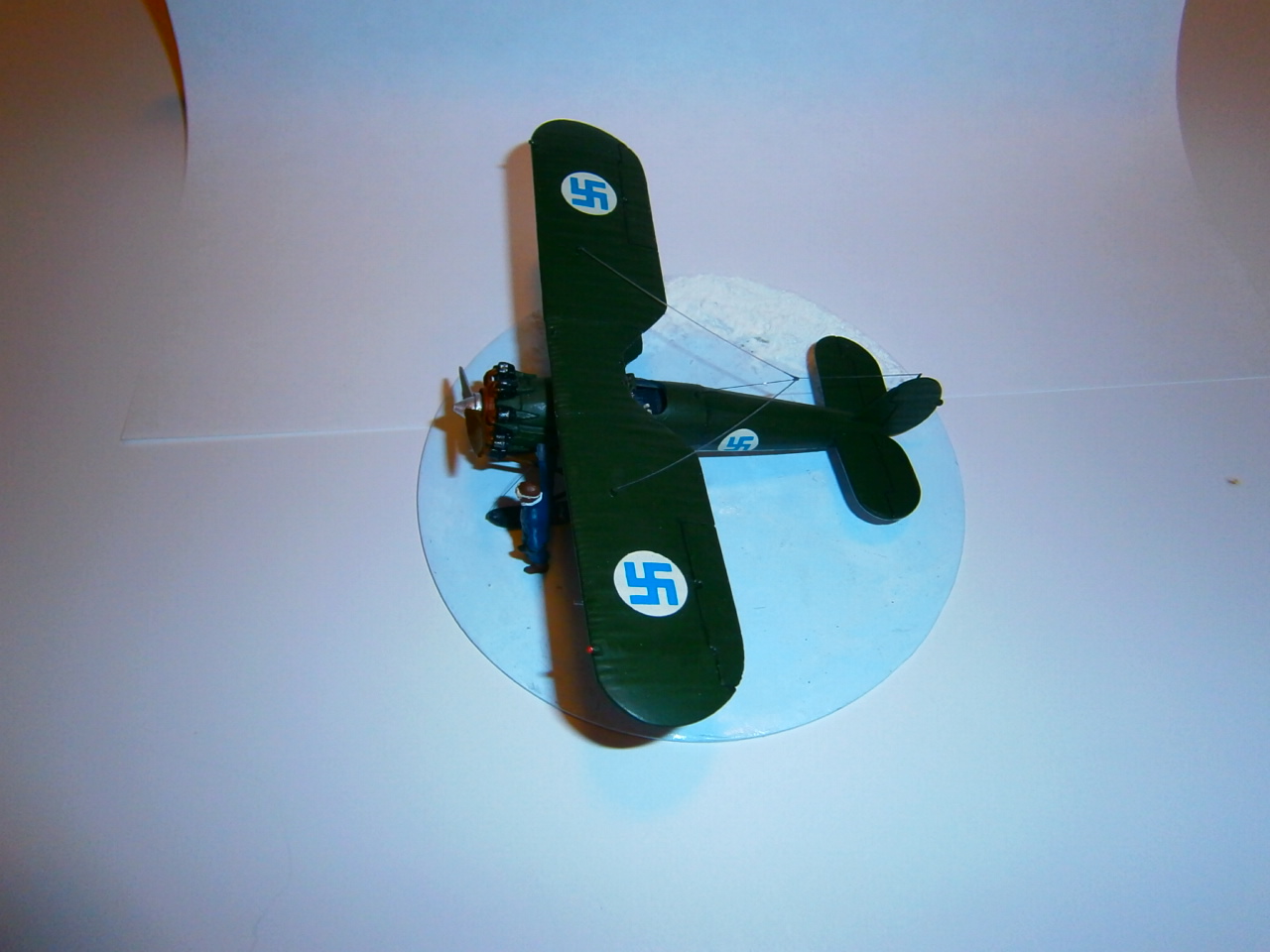
Bristol Bulldog in Finnish service


The Finnish Air Force signed an agreement on 24 March 1934 for the purchase of seventeen Bristol Bulldog Mk.IVA fighters. The aircraft were to be used as front-line fighters and were delivered to the country in February 1935. After the outbreak of the Winter War, the Swedish State donated two Bulldog Mk.IIAs,, which were received on 15 December 1939 and coded BU-214 and BU-216. The Swedish Air Force called the Bulldog for J7 (J=jaktflygplan which means fighter) and used twelve between 1931 and 1940. Several Bulldogs were lost when the Swedish Air Force conducted dive bombing trials in the 1930s.

The Bristol Bulldog was the first British fighter designed as an interceptor. When designed, it was thought to be fast enough to be able to catch up with the bombers of the late 1920s instead of defending own airspace by simply patrolling. The Bulldog was also equipped with both a transmitter and receiver, although the shortwave radio sets of the 1930s were heavy and of limited use. Many users of the Bulldog removed the radio sets, instead relying on hand signals of yesteryear.

During the Winter War Finnish Air Force claimed 2 victories with Bulldogs, and one Bulldog was lost in combat. The full story of the Bristol Bulldog in Finnish service can be found here: http://surfcity.kund.dalnet.se/bulldog_finland.htm

This Airfix kit is built to represent one of the two Bulldogs donated by Sweden to Finland. The kit is from the 1970s, but it was fairly easy to build. The cockpit was scratch-built, and the front skis came from an I-153 kit, while the tail ski also was scratch-built. The rigging consists of stretched clear sprue and the small 25lb bombs that came with the kit were replaced by resin bombs. The standing pilot - admittedly quite a tall fellow for 1/72 scale - came from the spares box. The CD that the aircraft is mounted on is painted to represent a frozen lake somewhere in Finland with a snow drift to the right of the Bulldog.

Tuesday, December 18, 2012

Boeing Washington B.1

A less known operator of the B-29 Superfortress was the The Royal Air Force, which used in all 87 former USAF as a stop-gap measure between the retirement of the Avro Lincoln and the deployment of the English Electric Canberra bombers. By acquiring the Boeing bombers, resources would not have to be diverted from the V-bomber program.The first Washingtons, as the RAF called the aircraft, arrived to the United Kigdom in 1950, and they served as long-range nuclear capable bombers in nine squadrons between 1950 and 1958. The last remaining Washingtons were used as Electronic Intelligence platforms by 192 Squadron.

Two Washingtons were transferred to the Royal Australian Air Force in 1952, where they were used by the RAAF Aeronautical Research and Development Uni to conduct trials for the United Kingdom's Ministry of Supply. Both aircraft were retired in 1956 and sold for scrap in 1957.

 Boeing B-29 Washington, WF502, Royal Air Force.

 Boeing B-29 Washington of 192 Squadron.

Thursday, December 13, 2012

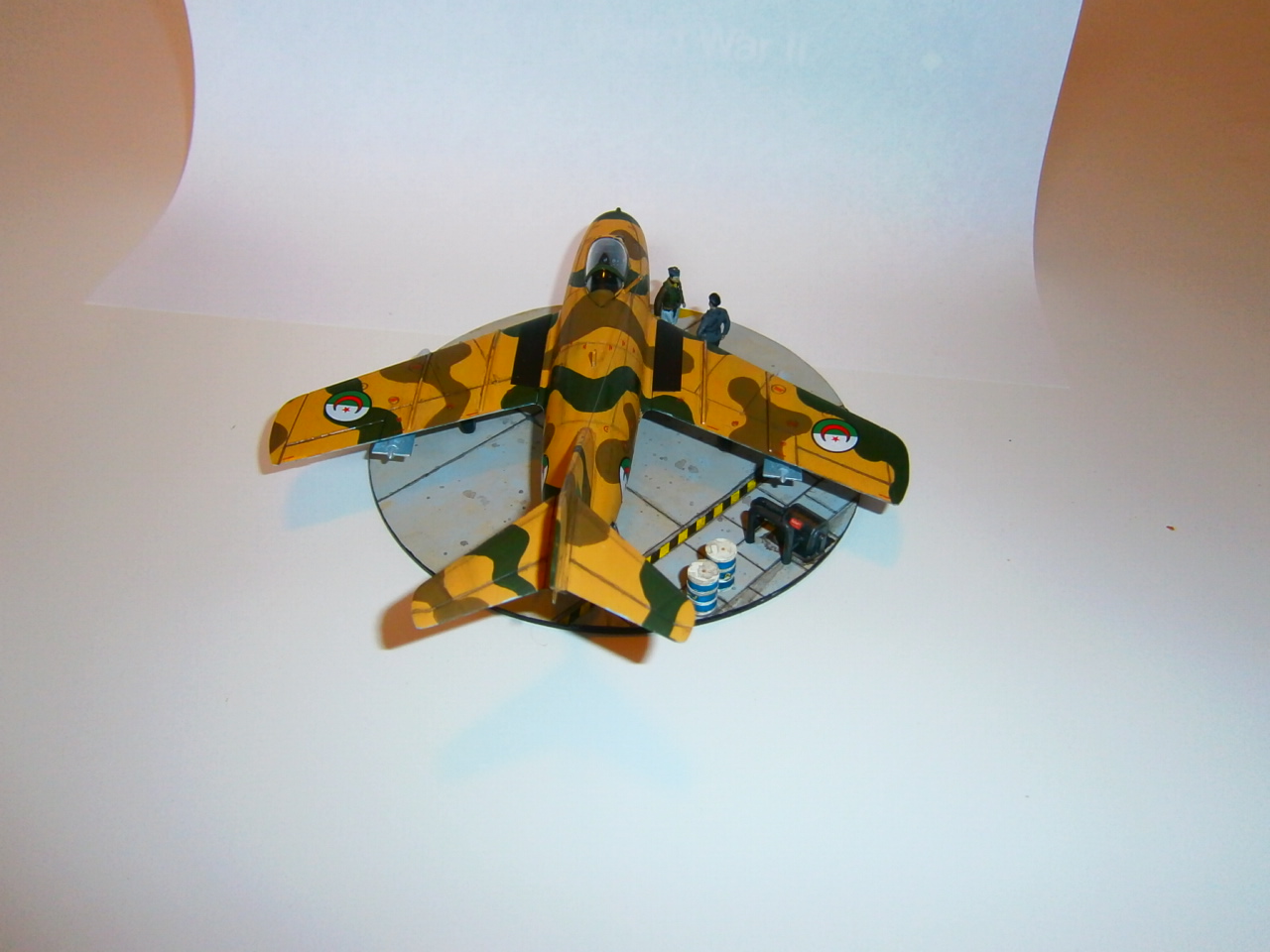
Algerian MiG-15bis


This is the new version of the Airfix 1/72 MiG-15, one of the first Hornby Airfix kits to be released. Much has been written about the somewhat deep and wide panel lines, but it is still a joy to build. In 1962 Algeria received five MiG-15UTI trainers as a gift from Egypt following the Algerian independence from France. The Algerian air force subsequently operated 20 MiG-15bis fighters.

U-1, a U-Boot typ IIA built in 1935


German submarine U-1 was the first submarine built for the Kriegsmarine. She was a type IIA U-boot, and she was built at the Deutsche Werke shipyards in Kiel, being laid down on February 11, 1935 and completed on June 29, 1935. Her crews were initially trained in the Netherlands.

Her pre-war service was unremarkable, and she did gain a reputation as a poor ship. Her rapid construction, combined with the inadequacy of the technology which was used to create her, made her uncomfortable, leaky and slow. When war came, there were already plans to shelve her and her immediate sisters of the Type II class for use as training boats only.

Owing to a shortage of available units she sailed on March 29, 1940 against British shipping operating off Norway, close to the limit of her effective operating range. She failed to find a target, but was sent out again on April 4 in preparation for Operation Weserübung (the invasion of Norway and Denmark).

U-1 sent a brief radio signal on 6 April, giving her position before she disappeared. The cause of her loss is unknown, but she was scheduled to sail through a minefield laid unbeknownst to the Germans by the British submarine Narwhal that same day. U-1 may have also been sunk by the British submarine Porpoise, which reported launching a torpedo at an unidentified enemy submarine subsequently thought to be U-3 on April 16 following the invasion. She was the first of over 1,000 U-boats to serve during the Battle of the Atlantic and one of over 700 to be lost at sea (Wikipedia)

The kit is the 1/400 Mirage kit, and it is detailed with the Mirage photo-etch. A simple and pleasant build that will conveniently fit in even a studio-sized apartment.