Sunday, January 5, 2014

SAAB S32 Lansen

The SAAB 32 Lansen (Lance) was the first Swedish aircraft to break the sound barrier, and it served well as an attack aircraft, a reconnaissance aircraft, a fighter, and later during its service life, as an ECM aircraft and a target-tower. The aircraft was produced between 1955 and 1960, and it served between 1956 and 1997. The A version (attack) was the first version to be produced following a request for an all-weather attack aircraft with integrated weapons and electronic systems. It replaced the SAAB B18 piston-engine bomber.

The A and S versions were described as being a bit underpowered, although quite pleasant to fly, whereas the J version had a stronger Avon engine, making it a good all-weather fighter for its era. The J version also carried four 30mm cannon as opposed to the A version's four 20mm cannon. The S version was the reconnaissance version, and only equipped with four cameras. As opposed to the Draken, SK-60, Gripen and Tunnan, Lansen was not exported to any other countries. There were attempts, though, as this ad proves:


The only 1/72 kit available is the Heller kit from the early 1980s. It is a good kit for its era with good fit, a detailed cockpit, raised but subtle panel lines but horrible decals! They silvered, refused to attach properly and repelled any decal solvent, but an acceptable result was had after much work and covering silvering with paint. The canopy unfortunately had a small bubble it the plastic, but since I couldn't find a replacement we will simply have to live with it.

Since the Heller kit doesn't come with any ordnance and since there was a dearth of Rb 05 anti-ship missiles on the market, I decided to go for the S 32 Lansen reconnaissance version. The decals represent an aircraft from the F11 Södermanland Air Force Wing based at Skavsta airfield in Nyköping during 1960. The S32s were used between from 1958, when it replaced the S 18 reconnaissance aircraft, and up to when the wing was disbanded in 1980.


Wednesday, December 18, 2013

Watermelons on the Road to Tobruk


The Italian Semovente with a 75mm L18 gun did serve the Italian Armed Forces fairly well. The HEAT shell could knock out most British tanks, and it served in both North Africa and Italy. This model is the Tamiya Semovente with markings from the Ariete armored division. Many details were added to the interior, for example radio, shelves, pistol ports, and levers in the driving compartment. Some photo-etch to the hatches and to the brackets for the pioneer tools as well as the engine vent. The figures are modified with various pieces, including a Hornet Carristi head, a fez and arms  from a Bosnian Gebirgsjaeger, and lots of putty. The Beretta is from an Italeri Italian parachutist kit, and I did not add a sling, since tankers tend to avoid things that snag in an AFV. The cart and the fruit is scratch-built. The base is a mix of plaster of paris with a dusting of baking soda. 


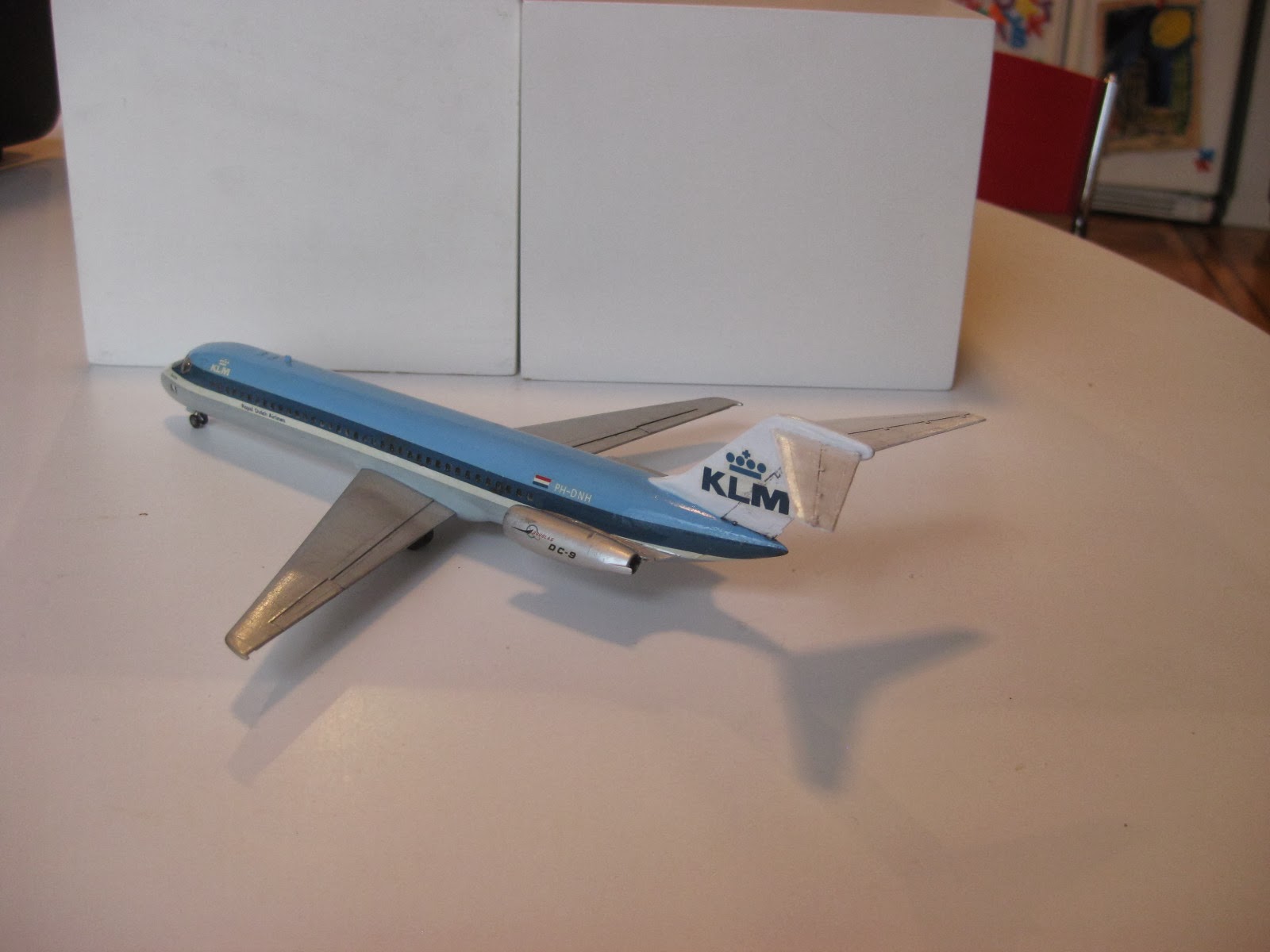
KLM McDonnell Douglas DC-9, an Airfix kit in 1/144 scale


The DC-9 was the aircraft that evolved into the MD-80, MD81s and other mid-range aircraft that can be seen all over the world today. This 1970s-era Airfix kit entertained me for more than a week while I was on a business trip and had some evenings in a hotel room. The decals were in very poor shape, but I had to make do with what I had immediately available, so there's plenty of patchwork and slight yellowing. The KLM livery was a nice change from military colors, though, and the kit came together rather nicely.