Since I have been working from abroad
for some time, modeling has been somewhat limited, and the projects a bit less
ambitious. My dear host did provide a sizeable cutting mat, though, and several
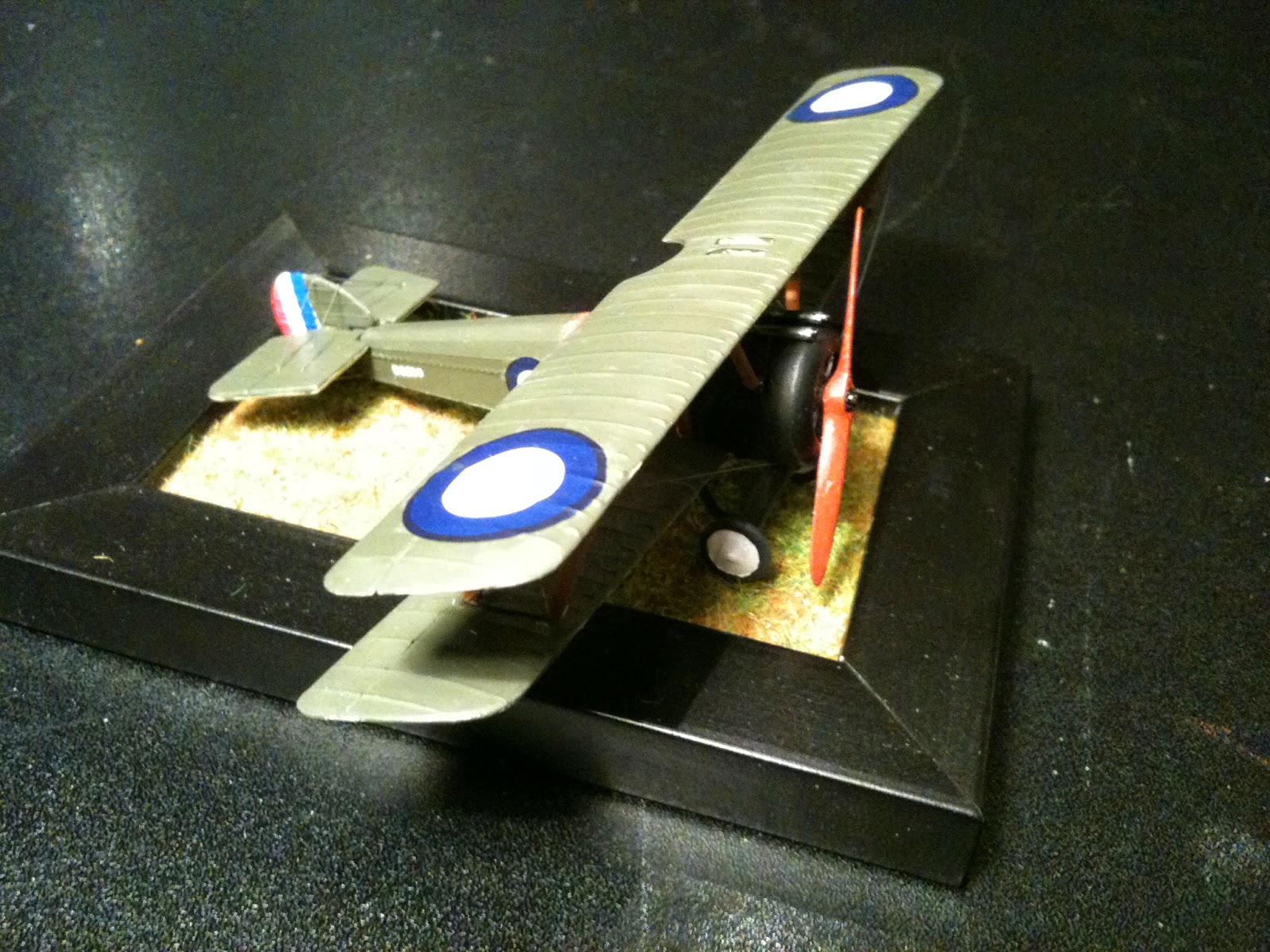
evenings were spent working on two Sopwith Camels, one from Revell and one from
Academy,
The Revell kit is originally from the 1960s,
and it was one of the few WW1 kits available in the hobby shop. The fit is
decent, although some details are lacking in both pilot and aircraft, for
example the rudder horns that were cut out of plastic card and super-glued to
the wings and tail and the protruding part of the machine gun barrels. Rigging
was made out of white sprue from a Roden kit, and the lines were painted dark
gray, The kit
was eventually mounted on a $2.50 photo frame.

Breadner
The decals provided with the kit were excellent, and they were used to adorn the Camel in the markings of Canadian ace Lloyd Samuel Breadner, CB, DSC. He was born in Carleton Place, Ontario, on July 14, 1894, and he received his pilot's certificate on Wright biplane after training at the Wright School. Breadner was commissioned into the Royal Naval Air Service (RNAS) on December 28, 1915, and he was promoted to Flight Lieutenant (RNAS) on December 31, 1916, before he was posted to Naval 3 (No. 3 Squadron RNAS) in 1917. He initially flew Sopwith Pups, and he even managed to shoot down a German Gotha bomber as his fourth victory on April 23, 1917. This was also the first Gotha to be shot down by the British over the Western Front. Breadner was awarded the DSC on May 23, 1917, and the citation reads as follows:
"For conspicuous gallantry and skill in leading his patrol against
hostile formations. He has himself brought down three hostile machines
and forced several others to land. On the 6th April, 1917, he drove down
a hostile machine which was wrecked while attempting to land in a
ploughed field. On the morning of the 11th April, 1917, he destroyed a
hostile machine which fell in flames, brought down another in a spinning
nose dive with one wing folded up, and forced a third to land."
Lloyd Samuel Breadner claimed in all ten enemy aircraft:
| Date | Time | Unit | Aircraft | Opponent | Location | |||
| 1 | 06 Apr 1917 | 1020 | 3N | Sopwith Pup (N5199) | Halberstadt D.II (DES) | Bourlon Wood | ||
| 2 | 11 Apr 1917 | 0845 | 3N | Sopwith Pup (N6181) | Albatros C (DESF) | Cambrai | ||
| 3 | 11 Apr 1917 | 0855 | 3N | Sopwith Pup (N6181) | Albatros D.III (DES) | Cambrai | ||
| 4 | 23 Apr 1917 | 1030 | 3N | Sopwith Pup (N6181) | Gotha G.II (CAP) | Vron | ||
| 5 | 23 Apr 1917 | 1730 | 3N | Sopwith Pup (N6181) | Albatros D.III (OOC) | Bourlon Wood | ||
| 6 | 29 Apr 1917 | 1115 | 3N | Sopwith Pup (N6181) | Albatros D.III (OOC) | SE of Cambrai | ||
| 7 | 23 May 1917 | 1345 | 3N | Sopwith Pup (N6197) | Albatros D.III (OOC) | Awoignt-Bourlon | ||
| 8 | 03 Sep 1917 | 0725 | 3N | Sopwith Camel (B3782) | Albatros D.V (DES) | Belhutte | ||
| 9 | 03 Sep 1917 | 0730 | 3N | Sopwith Camel (B3782) | Albatros D.V (OOC) | Belhutte | ||
| 10 | 11 Sep 1917 | 1150 | 3N | Sopwith Camel (B3782) | Albatros D.V (OOC) | Thorout |
(Source: theaerodrome.com)
Breadner continued serving with the Royal Canadian Air Force up to the Second World War, and he retired as Air Chief Marshal in 1945. Lloyd Samuel Breadner passed away in 1952.
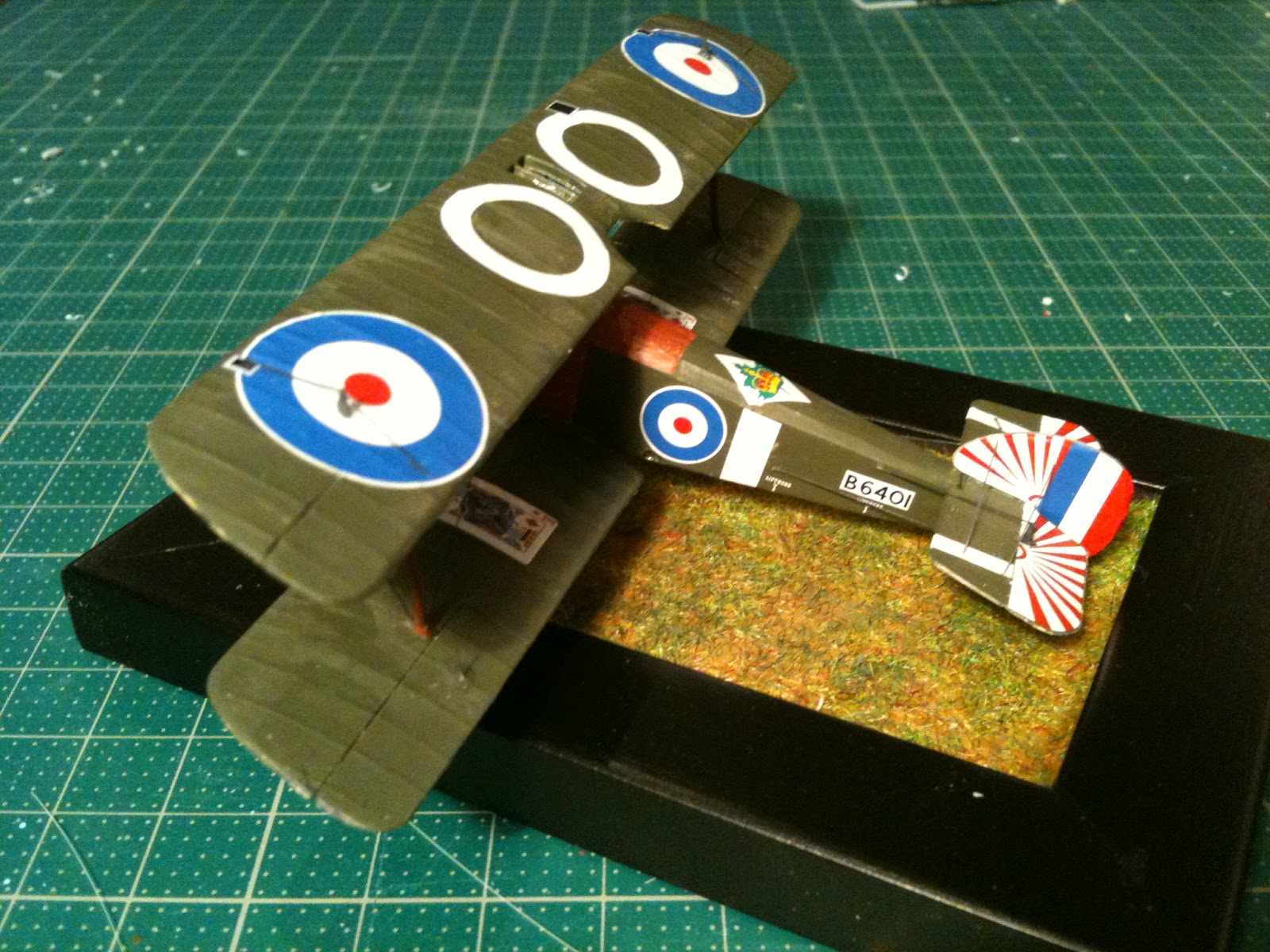
The Academy Camel is probably from the
1970s, and it is an even more basic kit. There is no cockpit at all, and no
pilot figure either. The Vickers machine guns are simply pieces of plastic with
no detailing whatsoever, the propeller had to be replaced with a prop from an
Albatros kit, and the decals were glossy and very difficult to adhere to the
kit. The colors of the tail decal were inverted, so the tail had to be
hand-painted instead. This kit was finished as a generic Camel with no
particular markings, and it was also mounted on yet another photo-frame. The
two Camels were photographed with an older iPhone, hence the regretful quality.
However, by now I should be back in the United States with full access to more
complete model building supplies.




Academy Camel below: