Thursday, September 1, 2016

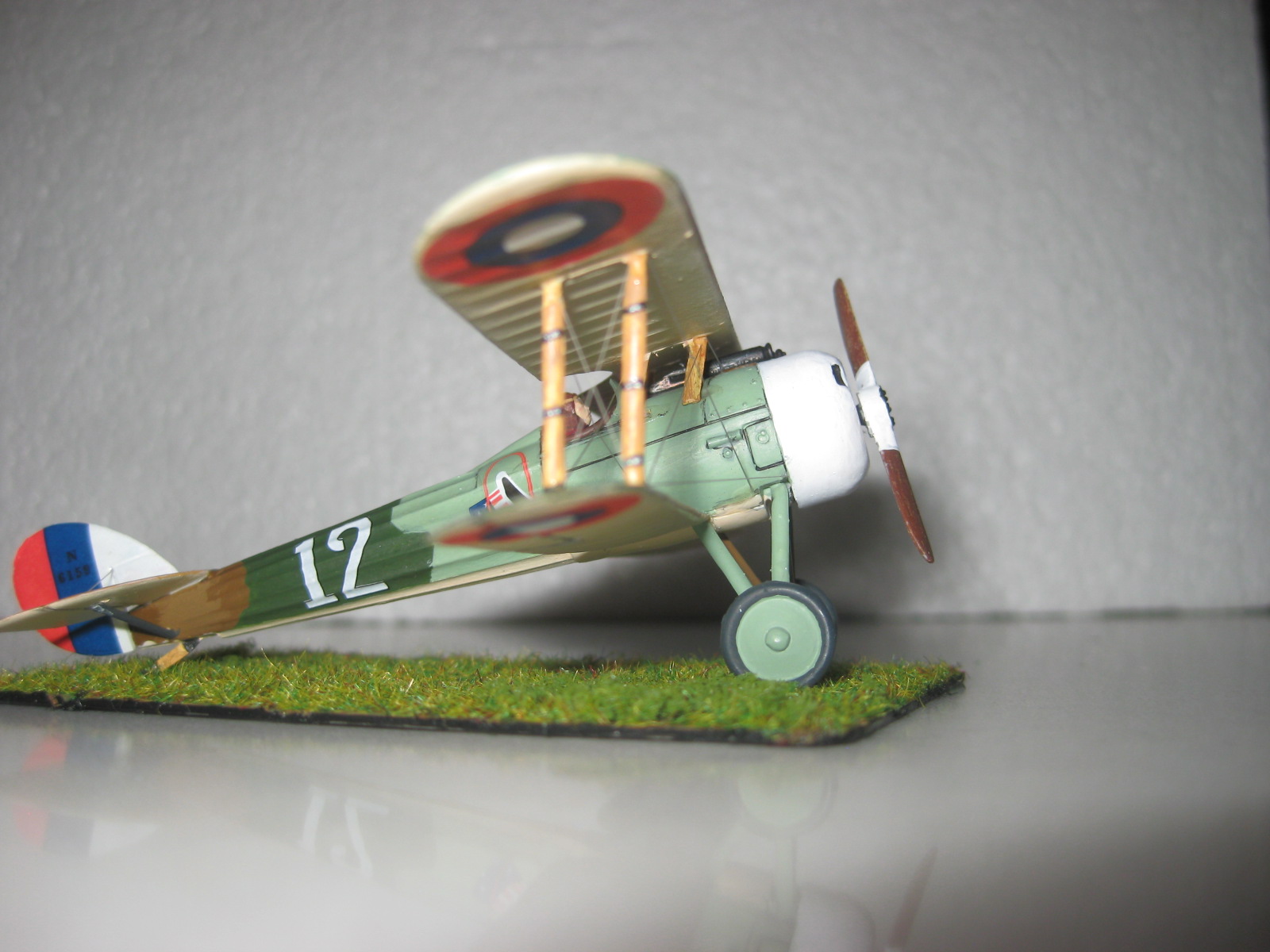
Eddie Rickenbacker's Nieuport 28C.1

The Revell Nieuport 28 kit is another classic, probably from the 1960s, and it has been issued in numerous boxings. The kit matched the size and proportions of the Nieuport 28 quite well, but the cowling is not nearly round enough. This is easily addressed with a sanding stick and a steady hand. I this case the kit is built entirely out of the box, and the rigging was the only addition. The Revell kit has a wonderful decal sheet with markings for Eddie Rickenbacker's 'White 12' as the only option. Edward Vernon Rickenbacker, America's Ace of Aces during World War One with 26 victories, was obviously a well-known aviator, so let us instead focus a bit on the aircraft, the Nieuport 28.

This aircraft was designed by Gustave Delage after a long series of Nieport sesquiplanes that started with the Nieuport 10 and ended with the Nieuport 27. They were all small and nimble fighters,  but eventually the SPAD VII and XIII offered better performance. The Nieuport 28 was an attempt to make ensure the competitive edge of the Societe Anonyme des Establissements Nieuport. The Gnome Type 9N Monosoupape was used to power the aircraft, and the traditional vee-type struts were replaced by parallel struts. The wing area was also increased by some 16 square meters, and the ailerons were moved from the upper wing to the lower wing where they were activated by torque tubes. The small size of the fuselage led to the machine guns being placed on the lower left side of the cockpit. However, even with all these improvements, the SPAD XIII remained superior to the Nieuport 28, and the Aviation Militaire rejected the design, and production was cancelled after an initial batch. Although the Nieuport saw limited service in the Aviation Militaire, the American Expeditionary Force was is need of fighter scouts. 287 Nieuports were purchased for $18,500 each, and the first ones reached the 95th Aero Squadron in February of 1918, albeit without machine guns. The Americans flew without armaments until late March.

The Nieuport 28 was indeed quite maneuverable, relatively fast, and it had a very good rate of climb, although the ceiling varied depending on the characteristics of individual aircraft. There were also several problems, for example the "composition board" material that covered the forward fuselage and that was likened to cardboard. The cowling was also known to catch fire if fuel was spilled on it in flight. Most importantly, the upper wing was known to shed it's fabric when pulling out of a steep dive. This happened to USAS pilots on at least six occasions, and lieutenant Jimmy Meissner from Brooklyn had to live through this harrowing experience twice. Fortunately there were no known casualties due to shredding of fabric, much because the ailerons were located in the full-sized lower wing.

Going back to Eddie Rickenbacker, just one more thing has to be mentioned: his distant cousin, Adolph Rickenbacker, was the co-founder of the Rickenbacker guitar company. Also, some photos from Eddie Rickenbacker's personal album can be found here: http://roadstothegreatwar-ww1.blogspot.com/2016/09/capt-eddie-rickenbackers-photo-album.html?utm_source=feedburner&utm_medium=email&utm_campaign=Feed%3A+RoadsToTheGreatWar+%28Roads+to+the+Great+War%29

 Rickenbacker in a Nieuport 28.

 Rickenbacker next to a Nieuport. Notice the small size of the fuselage.

White 12.

 The wing of Meissner's Nieuport after fabric had been shed.


Meissner's Nieuport after pulling out of a steep dive.


Sunday, August 28, 2016

L.F.G. Roland C.II

Yet another Airfix classic was completed today: the Roland C. II. Although the kit has been around since approximately the early or mid-1960s, it is the only OTS (One True Scale, i. e. 1/72) kit of this important aircraft. The dimensions are accurate, the figures are remarkably good, and the assembly is simple and quite fun to engage in. No profanities were used. This particular model was modified as to represent an early Roland with only an aft machine gun, in this case from a Roden kit. The Roland was also rigged, the wheels replaced, and the early type of half-hoops in front of the pilot to protect in case the aircraft overturned were scratchbuilt.

The Luftfahrzeug Gesellschaft (LVG) started off building airships in 1908, and they adopted the Roland name to avoid being confused with the LVG company, since "v" and "f" are pronounced similarly in German. The C.II appeared in October 1915, and the semi-monocoque fuselage influenced much of subsequent German aircraft design, and the Walfisch, as it was known, earned quite a bit of respect in 1916. It was used for a number of tasks, including the role of combat scout, that is fighter. British ace Albert Ball met several Roland aircraft during the summer of 1916, and he described the aircraft as the "best German machine right now...her guns fire backwards and forwards and everywhere except below". The Roland saw long service, and examples could be found flying over quiet sectors of the Western Front as late as the fall of 1917.

The decals of the kit were useless due to age, and I wanted an alternative marking anyway, so this Roland is painted and marked to represent an aircraft from Kasta 8, which was part of Kagohl II in mid-1916. It should be added that is was quite difficult to find out exactly what color the Rolands of Kasta 8 were. Some sources point to a very pale blue verging on white, while other sources indicate more of a light blue. I preferred the latter for aesthetic reasons. Kasta 8 was based at the Mont-Morville Aerodrome during May through June of 1916, and it was commanded by Victor Carganico throughout the war. The unit also included a young officer by the name of Manfred von Richthofen.