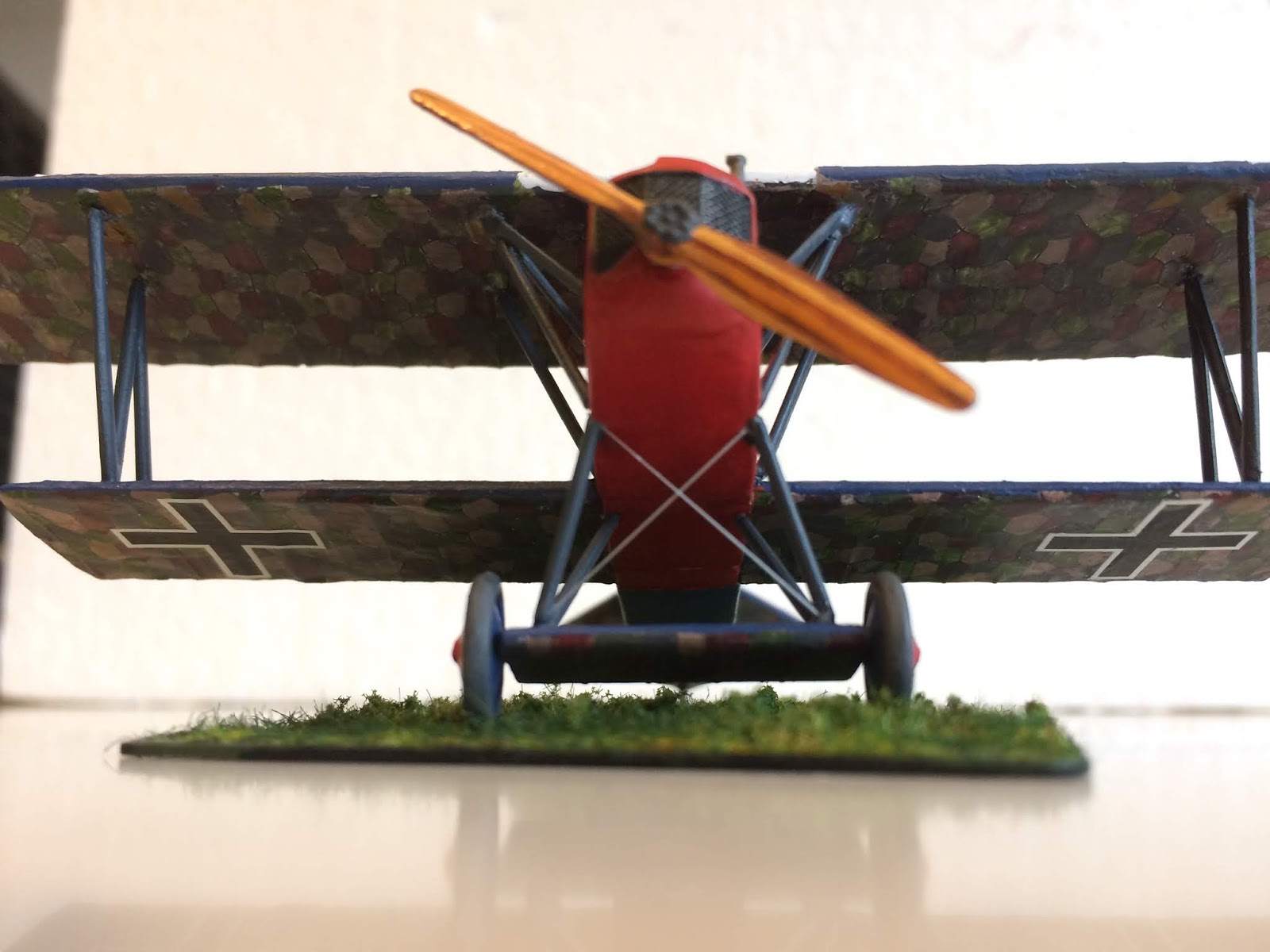
I found myself on a trip, and I had a spare evening. Therefore I picked one of those Revell kits with a model, paint. glue and a brush as well as black, brown and white paint to see what could be done. Metal would have to be provided by a pencil. The kit is from the 19060s, and the details are a bit chunky, but the scale and proportions are quite good. So is the fit. Sink marks and mold lines had to be filled and removed, though. The cockpit is only occupied by a so-called pilot on a peg, and with my limited selection of paints, I decided to scratchbuild a seat out of an old Metrocard and leave the pilot in the proverbial officer's mess. Now, the problem with this kit happens to be the decals. The lozenge underside decals just provide outlines, and you are supposed to fill in the colors yourself. I couldn't really provide a decent match with the limited amount of colors, but filling in the lozenges was actually almost meditative. The picture provides a garish image of what the colors actually look like. They are more muted in reality. The problem is that the decals to not stick properly. With nothing else available, I had to use some diluted white glue in a frustrating attempt to get the decals to stick to the wings and fuselage. The decals were also prone to shattering and not really flexible, so colorful language added to the red, blue and white of Berthold's aircraft. A very dark grey, almost black, wash provided some weathering of the engine area. The base is a hotel key card with some static grass that was added once I came back home.
Oskar Gustav Rudolf Berthold (24 March 1891 – 15 March 1920) became a pilot before the war by taking flying lessons in private. He becmae one of the first German aces, scoring his first victory in 1915 while flying an AEG G.II bomber as a gunship, since the Eindecekers were only allowed to fly defensive on the German side of the front lines. He flew for six units and cammanded five of them while scoring 44 victories. Sixteen were scored while flying one-handed as a result of one of his many injuries. Berthold was killed by a mob in Hamburg in 1920 while fighting with one of the post-war Freikorps. Contrary to popular myth, he was not strangled with his own Pour le Merite.
Saturday, May 19, 2018
Friday, December 15, 2017
Hawker Hunter FGA.9
It has been argued that the Hawker Hunter is the most beautiful jet aircraft ever built. I'm not sure about that, although it is quite aesthetic with a long fuselage bracketed by both curved and swept-back wings over large triangular air intakes. The Hawker Hunter was also one of the most successful British aircraft exports of the post-WW2 era, with almost 2,000 Hunters being build and used by in all 22 nations.
The FROG model is a late ground-attack version of the Hunter, the F.G.A.9, in this case armed with cannon and rocket pods. This kit is probably from the late 1960s or very early 1970s, and it is typical of FROG models of this era: thick, hard plastic, raised panel lines, but decent fit and accurate proportions. The kit comes with RAF and Swiss Air Force markings, and I chose the markings of a Hunter from No. 58 Squadron based at West Raynham around 1968. Painting was done with Vallejo colors, and the kit is built entirely out-of-the box while being seconded to Riga, Latvia. Further reviews can be found here:
https://modelingmadness.com/review/korean/previews/F207.htm
https://designer.home.xs4all.nl/models/hunter72/hunter72-main.htmConvair F-102A Delta Dagger, California Air National Guard
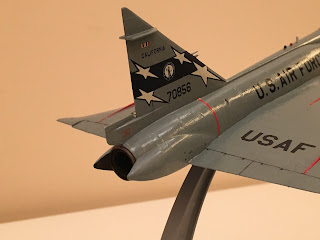
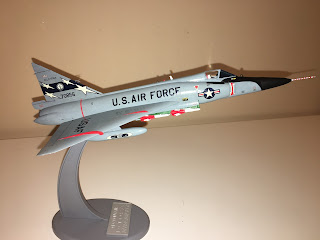
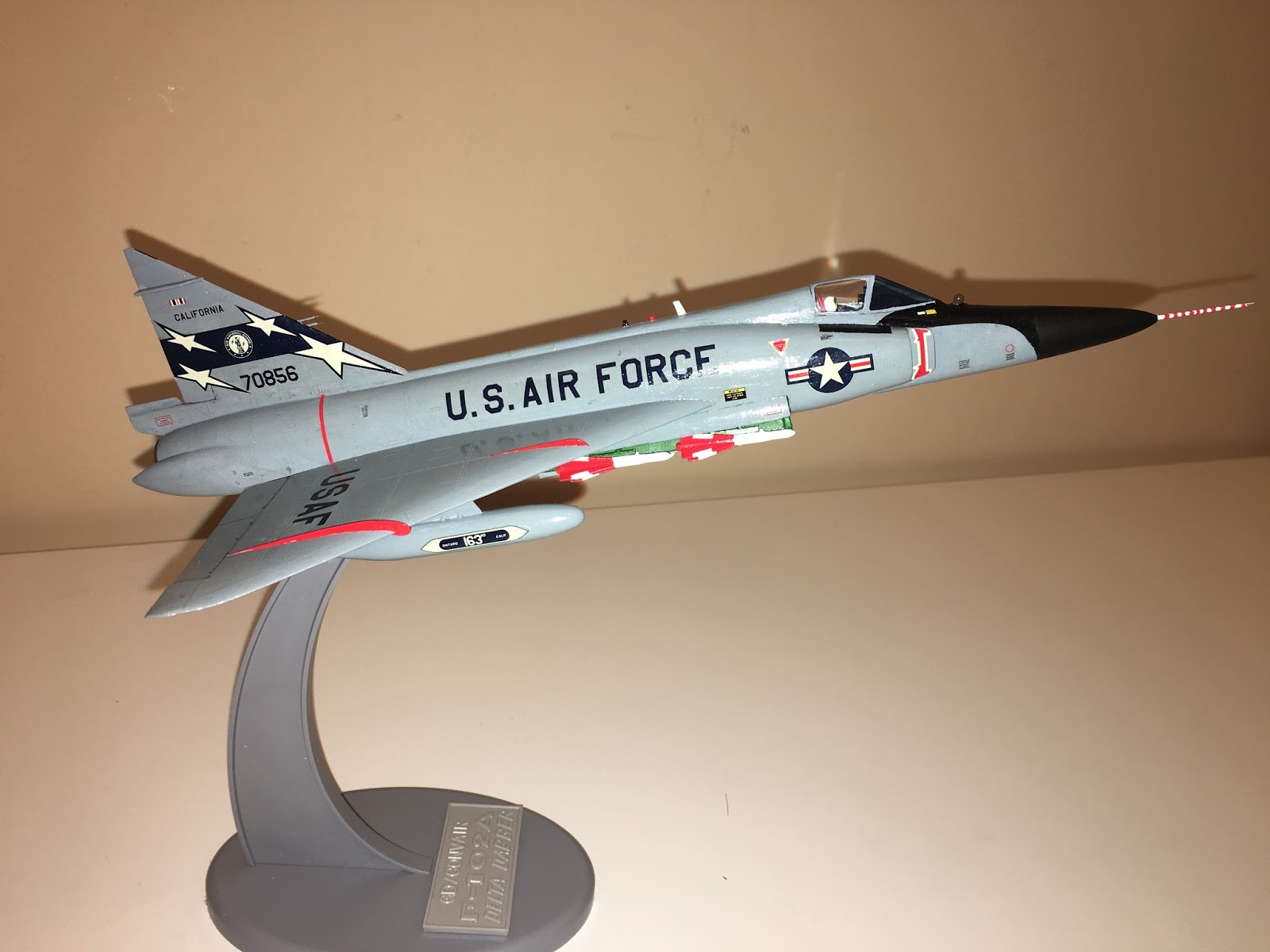
High-performance jets of the 1950s and 1960s have a certain charm. It was the era of faster and higher, of a Few Good Men, and of everlasting technological optimism. The Convair F-102 was part of that era, being a supersonic interceptor meant to be guided by Air-Ground Intercept (AGI) to shoot down Soviet bombers before they dropped their nuclear payloads over American cities. This kit featured the markings of the California Air National Guard's 194th Fighter Squadron. They flew F-102A Delta Daggers from July 1, 1964, having replaced the old F-86Ls with the all-missile Mach 1,25 interceptor. The Delta Daggers were in turn retired on January 1, 1984 and replaced by F-4D Phantom IIs.
It seems as if this kit was released just before recessed panel lines became the norm. The raised lines are subtle, and yet they convey the image of this interceptor. There are several quirks, though: the fin has a third of its plastic presence on the left hull and roughly two thirds on the right side, which means that careful fitting, filling and sanding is required. The tail decal fortunately covers up much of this. The lower wings are also fitted behind the front leading edge of the upper wing, and this requires careful fitting. Although I chose to display the model in flight, the landing gear can be improved. The pilot is underscale or just representing a rather diminutive aviator..The Falcon missiles are crude, although resin replacements can be purchased. Finally, all online sources warned against assembling a closed missile bay. There are insertable closed missile bays available in resin, but I opted for an ascending Dagger, ready to pounce on Soviet strategic aviation approaching the West Coast. On the Bright side, other aspects of the fit are quite good. The cockpit is rather decent for a late 1960s/early 1970s kit, and there are decals to further highlight the instrument panels. The decals were still quite useable, and the canopy was reasonably clear. Above all, great fun was had from a kit that cost roughly $10 at Hobbybokhandeln in Stockholm, a really good used model shop and book store.
Labels:
1/72,
Califormnia Air National Guard,
Convair,
Delta Dagger,
F-102,
hasegawa
Subscribe to:
Posts (Atom)