Showing posts with label Dragon. Show all posts

Wednesday, February 26, 2014

T-34 in Stalingrad

The Battle of Stalingrad was obviously one of the pivotal events of WW2, and these desperate times did call for desperate measures. The STZ, or rather the Stalingrad Tractor Factory named after Feliks Dzerzhinsky (Сталинградский тракторный завод им. Ф. Э. Дзержинского) was designed by an American architect, Albert Kahn, and it opened in 1930. It was also to become one of the pivotal locations during the Battle of Stalingrad.

The T-34 tank was initially manufactured in Charkov, but with the tank showing much promise, the manufacture was expanded to the STZ plant with assistance from Factory No. 264, the Stalingrad Barge Works, and Factory No. 221, the "Barrikady" artillery foundry. Another plant to manufacture T-34 tanks was Factory No. 112, "Krasnoye Sormovo." The first tanks was manufactured in early 1941, and over time some unique design features appeared in the STZ T-34, most notably the perforated metal road wheels, "chisel" mantlet, and other details. Although production was halted during the height of the battle, by early 1943, some 3,770 T-34 tanks had been produced by the STZ plant.

There are persistent anecdotal recollections of tanks being driven out directly from the STZ production lines into combat. These would have been unpainted or only covered by iron oxide primer, lacking sights and other accessories, and manned by factory workers of both genders. This is featured in Anthony Beevor's "Stalingrad" as well as many other sources, although these stories are emphatically denied by armor expert Cookie Sewell. The photo below is claimed to be of a knocked out in Stalingrad, and it is definitely lacking fenders, headlights and other details, although the photo doesn't answer the question whether it is painted or not.  


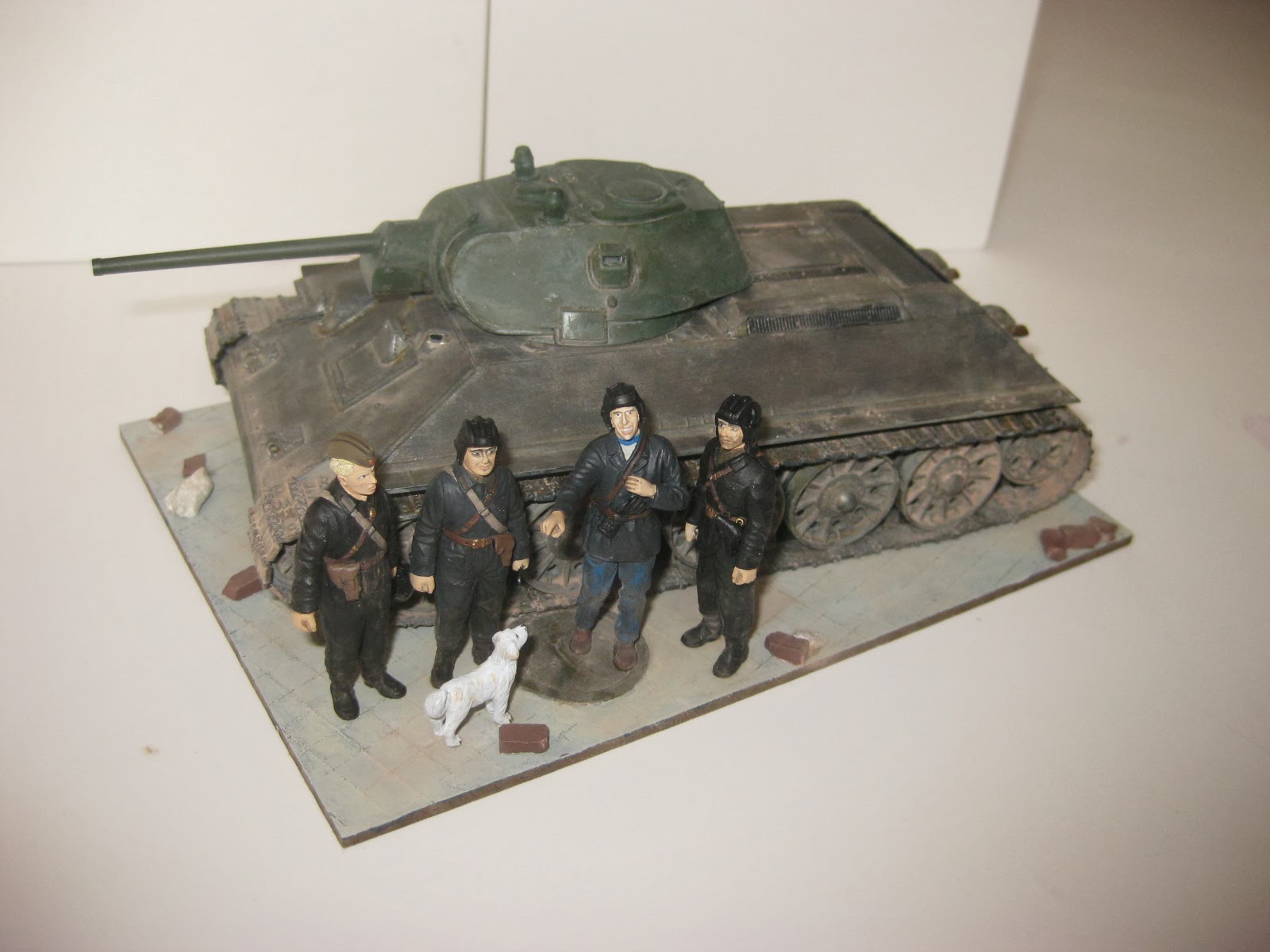
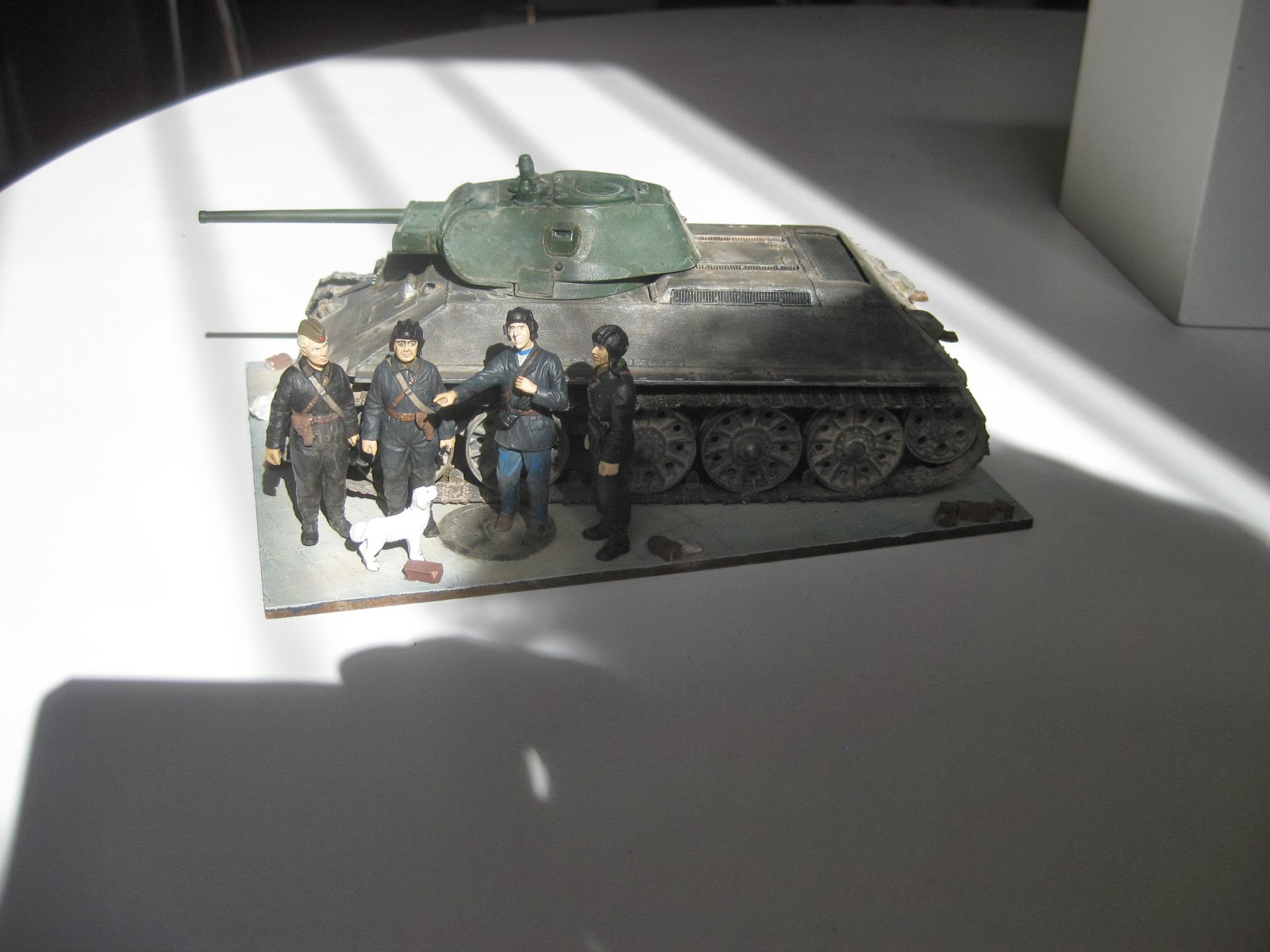
For the sake of experimentation, let us assume that the STZ produced and repaired tanks with or without paint until he last possible minute. The T-34 model below represents a mix of components. The kit is based on a Dragon T-34 model 41, and it is fitted with STZ road wheels, although not a STZ turret. Perhaps the hard-working laborers of the STZ plant married a working turret from a less hastily produced T-34 model 41 (B 2/11 would stand for bashnya/turret two of eleven) to a STZ chassis sans accessories, thus producing this beauty? The figures are a mix of DML, ICM and Verlinden, with a Trumpeter animal friend. The commander may very well be a factory worker, since he is wearing civilian clothing and a tanker's helmet. Now let's roll out and beat the Fascist invaders, shall we?  


Thursday, May 23, 2013

Saab J35D Draken


The SAAB J35 Draken entered service in 1960 and served within the Swedish Air Force until 1998. It also served with the Austrian, Danish, and Finnish Air Forces. The J35 was intended as a high-altitude interceptor, but it performed quite well at lower altitudes as well. The characteristic double-delta wing makes the aircraft stand out to this day. The name "Draken" meand both dragon and kite, although some of the engineers working on developing the aircraft in the 1950s claim that the name refers to the airframe's similarity to a kite, and not the fire-breathing monster.

The kit is the Airfix J35F, originally marketed in 1970. The kit has several errors, such as the exhaust, the intakes, the pitot tube and some other minor issues, but it is easy to assemble and definitely looks the part of a J35, however with the early style canopy and the two cannon (one in each wing) the Airfix kit is more akin to a J35D, and hence I removed the IR sensor under the nose and the inlets on the spine to make a J35D. This version was the fastest of the J35 versions, being equipped with a Rolls Royce Avon 300 (RM 6C) which could deliver 77.3 kN of thrust with the afterburner turned on, making it able to accelerate until out of fuel. It was also the last J35 to carry two cannon. The D version was introduced in 1964.

Back to the kit: I decided to paint it in silver, a style typical of early Draken interceptors. I omitted the Rb27 and Rb38 missiles, which were the Swedish designations for the Hughes Falcon AAM, but added fuel tanks from the Revell Draken kit.


Although not immediately obvious in the photo, these particular J35s have one of their fuel tanks painted both green and grey. If this is to differentiate the left tank from the right tank or just to try out different paints is unknown to me. Please do let me know if you have an explanation.

Besides national and tactical markings, I added the unit insignia from the F13 Fighter Wing in Norrköping with the crest of the city depicting the patron saint, Saint Olaf, and a red eagle. The motto reads "Altius Citius Pericula Commoda Suscipientes", or "higher and faster with risks worth taking". However, this emblem was introduced in 1968, when I believe that most J35s had been painted in a green/grey camouflage pattern, so I will have to claim artistic license for the addition of the unit insignia. The aircraft is mounted on a CD painted to look like one of the roadway bases used by the Swedish Air Force during the Cold War. A no-parking sign was added for the sake of levity.

Also, please enjoy the clip above, which is from 1968 featuring a young Agnetha Fältskog of ABBA fame singing the praise of the J35!