Showing posts with label dassault. Show all posts

Friday, January 24, 2014

Dassault Super Mystère

The Dassault Super Mystère was first flown on March 2, 1953, has the distinction of being the first European aircraft to break the sound barrier. It was similar to the North American F-100 Super Sabre, the Soviet MiG-19 and somewhat similar to the SAAB J-32 Lansen. The Super Mystère served with the air forces of France, Israel and Honduras, being retired from the Armee de l'Air in 1977.

It served in the Israeli Air Force (IAF) as the Sambad (a Hebrew acronym of "Super Mystère B Deux") from 1959 and it acquitted itself well against MiG-17 and MiG-19s, although the engine was found to be weak. Initial dogfights in the early 1960s did not result in any enemy aircraft shot down despite some excellent opportunities. It turned out that the 30mm DEFA cannons rounds were set for delayed detonation, which was ideal for bringing down Soviet bombers, but not jet fighters. As the Dassault Mirage entered IAF service, the Super Mystère began flying ground attack missions, and the IAF Super Mystères were heavily engaged in the 1967 war. 507 sorties were flown during the war and nine Super Mystères were lost, while five enemy aircraft were shot down. The Super Mystère pilots did encounter MiG-21s during the war, but despite being outperformed, the IAF pilots managed to evade the MiG-21s and on at least one occasion shoot down two Egyptian MiG-21s. The IAF Super Mystères were upgraded in 1969 with stronger engines to the Sa'ar (Tempest), and it served into the 1970s. The air force of Honduras operated Super Mystères between 1976 and 1996.

The model is the Airfix Super Mystère from the early 1970s, and it is one of the better Airfix kits of the era. The raised panel lines are discreet, and the cockpit has a reasonable amount of detailing. The fit was quite good, with the exception of the cockpit, and the decals were in good shape, although the blue had faded. The markings are of an aircraft belonging to the EC 2/10 'Seine' squadron in the mid-1960s, which had two escadrilles, the Cercle de Chasse de Paris, which was founded in 1934, and SPA 76, which originated from 1916, although it was disbanded between 1919 and 1938. During the Second World War the escadrilles  formed the fighter squadron GC III/10. The Super Mystère was in use between 1959 and 1968, after which the squadron flew the Mirage IIIC until 1985, when the squadron was disbanded.


Sunday, February 10, 2013

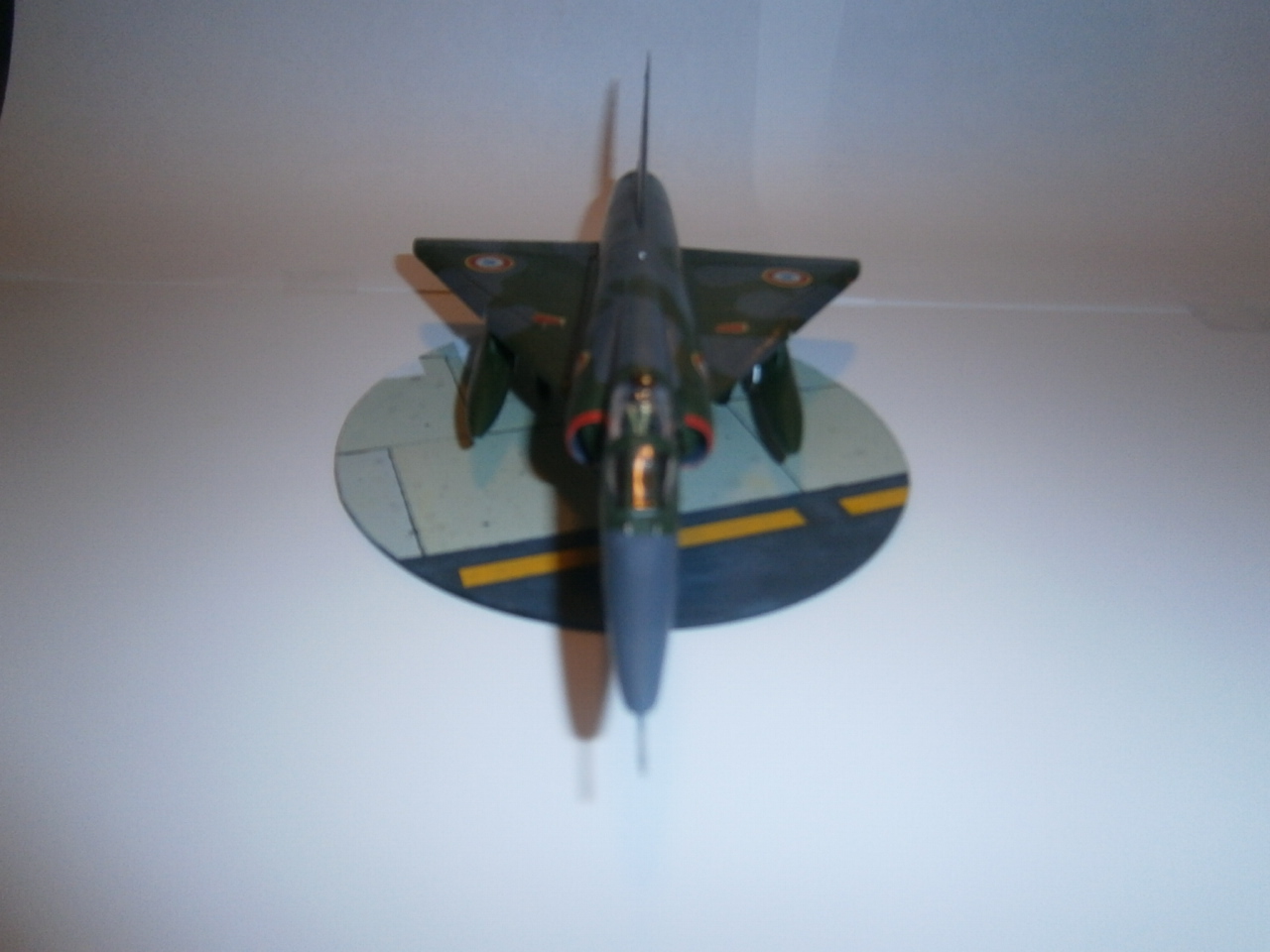
Dassault Mirage IIIR from ER 3/33 'Moselle', Strasbourg-Entzheim, early 1970s.

The iconic French Mirage fighter came in many versions, including this reconnaissance version that replaced the RF-84F Thunderflash in French service. It was also used by Abu Dhabi, South Africa, Pakistan and Switzerland.

The navigational calculator of the IIIR was not up to par, and a modernized version was designed to be fitted with systems from the Mirage IIIE. ER 3/33 'Moselle' was the only unit to use this modernized version of the IIIR, the Mirage IIIRD, this version having the same Doppler effect Cyrano radar as the IIIE (the designation 'D' was for Doppler). The 'Moselle' squadron received these aircraft between 1967 and 1969, and they were eventually replaced in 1988. Twenty Mirage IIIRD were delivered to the Armee de l'Air, and they were in turn replaced by the Mirage F1CR.

A Mirage IIIR was used by Jacqueline Auriol to improve her closed-circuit speed record on June 14, 1963, when she completed the course at an average speed of 1,268.75 mph or 2,030 kph.

The Revell 1/72 Mirage III is from the 1970s, and it retained some of the features of an era when models were built to be toys: a canopy that could be opened, an engine that could be pulled out for examination, and wheels that could be made to roll. It is nice kit for its era, and it provides markings for Mirage IIIE, IIIS, IIIRS and IIIRD aircraft of the French and Swiss air forces, although the decals were quite disappointing. The Mirage was painted in Vallejo colors. Headlights and front antennae were added to the kit.