Showing posts with label first world war. Show all posts

Tuesday, May 24, 2016

SPAD XIII of Georges Felix Madon, SPA38, 1918


 Caporal, later capitaine Georges Felix Madon was born on July 28, 1892 in Bizerte, Tunisia. He was a short but remarkably strong man who played soccer and boxed. Madon became interested in aviation at the young age of 15, and he tried to build his own aircraft. This venture was not successful, but he continued building kites and models, including a bicycle-powered "aviette". As he grew older, he attempted to become a pilot in service of the Ottoman Empire, but he was not accepted into the Sultan's service. Manon then enlisted in the First Engineering Regiment in Versailles, where he became a cook. However, he continued requesting pilot's training, and he qualified as a pilot in June 1911 after 19 lessons, and he received a military pilot's license in January 1913 after training at Avord in France.

Madon was initially assigned to Escadrille BL30, where he reconnaissance missions in Bleriots. He also flew some of the first night-time bombing missions of the war. Madon was already a very experienced pilot, and this served him well when he was hit by a 77mm shell on October 30, 1914. He managed to perform a dead stick landing against the wind, but behind the French lines. 

 Madon

On April 5, 1915, Madon was thrown off course by heavy fog while qualifying on a new Farman, and he landed by mistake in Switzerland, where he was promptly interned. Madon had little interest in remaining in Switzerland. It took him two attempts, but on December 27 he escaped by chloroforming and kidnapping his guard.

Madon was subsequently posted to MF218 and promoted to sergeant. He flew fire-direction missions for some time, but he requested transfer to a fighter escadrille. Madon was re-qualified for fighter aircraft at Pau and Cazaux, and he was posted to the Nieuport-equipped escadrille N38 on September 1, 1916. He shot down his first enemy aircraft on September 28.Three more followed in 1916, and he was promoted to Adjutant.  

Madon remained in action through most of 1917. He was wounded on July 2, 1917, after a mid-air collision with an enemy aircraft, and was commissioned a sous-lieutenant in August. Madon seems to have favored engaging the enemy at very short distances. Besides the mid-air collision in July, it is said that he returned with blood and brain tissue on his propeller on three separate occasions, and he once snagged an enemy observer's spectacles in his rigging. By October 1917 Madon's score had risen to 17 confirmed victories with another 20 unconfirmed, and by March 9, 1918, he had claimed 25 aircraft.

Madon assumed command of escadrille SPA38 om March 24, 1918, a unit that had just been re-equipped with the new SPAD XIII. The unit was tasked with photo reconnaissance and patrolling, and it had already received two unit citations for having downed 60 enemy aircraft when Madon took command. SPA38 adopted the black thistle that was used as a personal symbol by Madon alongside his motto "Whoever rubs aginst me gets pricked". Like Manfred von Richthofen, Manon painted his SPAD red to make it easier to identify, both for friend and foe. An earlier SPAD XIII, S484, was painted with an all-red fuselage, but this later mount had a white radiator ring.


SPA38 fought in the skies above Cuvilly and the Mareuil and l'Epinette forests, and in May, SPA38 was assigned to the 7th Army. The escadrille was engaged against advancing German forces in the Courcy and Leuilly areas between May 27 and June 5, and on July 5 SPA38 became part of Groupe de chasse (GC) 22 together with SPA87, SPA92 and SPA152. This unit fought mainly in the Champagne area under the 4th and 5th Armies up to the final advances of the war. Besides Madon, SPA 38 included the following notable pilots:  Hector Garaud (13 victories), Jean Casale (12 victories), David Putnam (12 victories), Gustave Douchy (9 victories), and Jean Romatet (7 victories). Madon played a significant role in mentoring these pilots and developing their tactics. He also got to fly the SPAD XVII with a 300 h.p.Hispano Suiza engine. However, only about 20 of these excellent aircraft were completed before the Armistice, "for which", observed Madon, "let the Boches be thankful".

Madon ended the war with 41 confirmed victories out of 100 claims. This made him the fourth ranking ace in the French Air Force. When asked about his unconfimed victories, he simply claimed that "the Boche knows his losses". Madon was promoted to a temporary Capitaine on Armistice Day, and he was also made an Officier de la Legion d'Honneur. Madon was killed in a tragic flying accident in 1924 while flying in tribute to Roland Garros. The Avord Air Base in France is named "Base Aérienne 702 Capitaine Georges Madon" in honor of Madon's long service to his country.


The Model

The kit is an old Esci SPAD with all the shortcomings of a 1960s kit. It has, however, recently been re-boxed by Italeri. and it comes with a glorious decal sheet that will be saved for an Eduard SPAD at some later date. I do really like the SPAD, especially the SPAD XIII. It looks very art deco to me, having somewhat of the looks of a sports car, and lacking the blunt appearance of the Camel, the angular quirkiness of an SE.5a, or the steampunk radiator of a Fokker D.VII. I added a windscreen, rigging and a new propeller, but otherwise the kit is out of the box with decals from the spares drawer. The kit is actually a bit underscale for 1/72, and it probably measures up to 1/76.  


Sources

http://www.escadrilles.org/armee-de-l-air/spa-38/
http://albindenis.free.fr/Site_escadrille/escadrille038.htm
http://www.theaerodrome.com/aces/france/madon.php
Jon Guttman. SPAD XII/XIII Aces of World War 1
Joseph A Phelan. Heroes & Aeroplanes of the Great War 1914-1918

Sunday, October 6, 2013

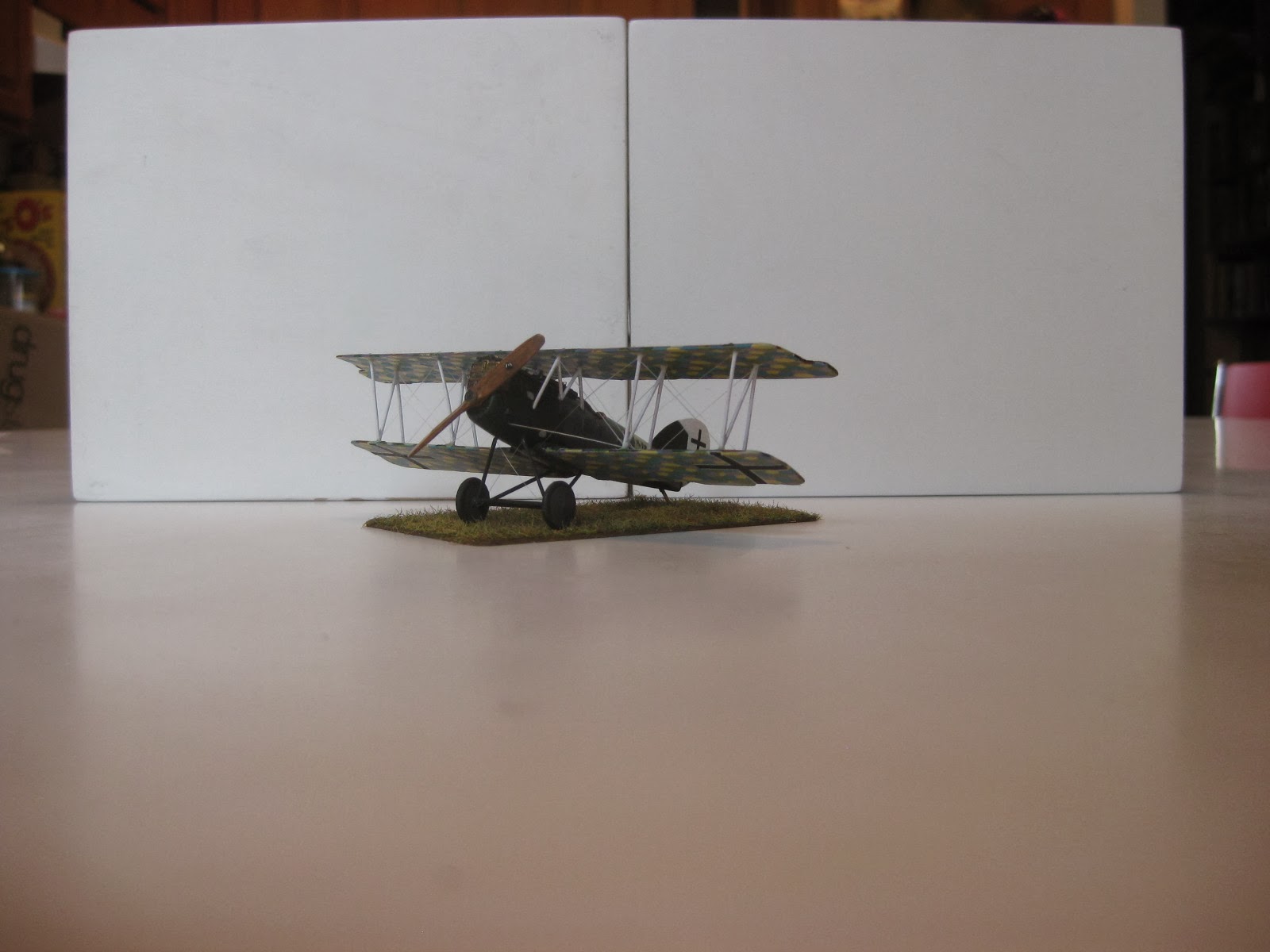
Pfalz D.XII

The Pfalz D.XII was a contemporary of the much more well-known Fokker D.VII. The Pfalz was not by any means a bad aircraft, but it was less maneuverable than the Fokker and the controls were heavier, although it could dive at much higher speeds. It was also very sturdy for a WWI aircraft. The Pfalz entered service on June 30, 1918, and around 800 planes were built before the Armistice. It was often used in combination with the Fokker D.VII, usually operating at a lower altitude than the better climbing Fokker D.VII.

The Pfalz was used in Jastas from the Kingdom of Bavaria, since Bavaria had sponsored the development of the fighter, and by Jastas on more quiet parts of the front. It seems as if Jasta 35b (the letter "b" was the designator for Bayern, or Bavaria) flew D.XXIs - and Fokker D.VIIs - with similar markings, so let's just assume that this particular Pfalz comes from that unit. Jasta 35b was indeed a Bavarian unit, managed to score 44 victories during the First World War. It suffered six members killed in action and four in flying accidents while nine were wounded in action, five were injured in flying accidents while two became prisoners of war. The following officers commanded the Jasta while the Pfalz served in the unit:

Otto Fuchs: 21 April 1918 - 7 July 1918
Rudolf Stark: 7 July 1918 - 11 November 1918

One source that an officer by the last name of Gratz commanded the unit between July 28 and August 8, 1918. If this is the case, Gratz may have been an acting officer while Stark was on leave or otherwise occupied.

The unit was stationed at the following airfields during the corresponding period:

Cambrai-Epinoy: 18 April 1918 - 28 August 1918
Lieu Saint Armand: 28 August 1918 - 29 September 1918
Bühl, Saarburg: 29 September 1918 - 12 October 1918
Givry, Mons: 12 October 1918 - 29 October 1918
Gosselies, Charleroi, Belgium: 29 October 1918 - 11 November 1918

Leutnant Rudolf Stark

Leutnant Rudolf Stark, the commanding officer of Jasta 35b in two periods during the summer and fall of 1918, was born on February 11, 1897, probably in Bavaria. He initially served with the 2nd Royal Bavarian Uhlans, and he was decorated with the Bavarian Military Merit Order on September 29, 1915 and the Iron Class, 2nd Class, on June 11, 1916. He subsequently applied for transfer to an aviation unit and he was posted to FA(A) 296, a reconnaissance unit, on either November 15 or November 17, 1917. However, he soon applied for fighter duty, and he joined Jastaschule II for training as a fighter pilot. Following training, Stark joined Jasta 34b on January 18, 1918, and he scored five confirmed victories during the spring of 1918. Stark was then appointed as acting unit commander of Jasta 77 on May 24, and he scored his sixth victory on the day he after he arrived. 

On June 7, 1918, Stark was reassigned to Jasta 35b as Staffelführer, scoring an additional five victories beginning on July 1. Stark had flown a Fokker DR. I triplane during at least some of his time with Jasta 77 and initially with Jasta 35b, but the latter unit was soon was re-equipped with Fokker D. VII and Pfalz D.XXI biplanes. 

The D.VII was a popular aircraft, but the Pfalz was a less well-known quantity. Stark summed up his impressions of the Pfalz as follows: "What is a Pfalz D.XII? No one has ever heard of such a machine, and no one knows anything about it. We decline to take these machines. The result is a series of long telephone conversations. We are told that they are very good, better than the Fokkers in some regards (eyewash!!) and we must take them. There are no more Fokkers to be had, and in any case these new Fokkers are better than the Albatros, and when new Fokkers come along we can take them in exchange. All right then, we'll have the Pfalz. Each of us climbed in the new machines with a prejudice against them and immediately tried to find as many faults as possible. The Staffel opinion was the same a as ours. The Werkmeister grumbled because of the trouble the rigging was going to make for him, while the mechanics cursed because of the extra work to assemble and dismantle them and declared them awkward to handle. No one wanted to fly those Pfalz except under compulsion, and those who had to make as much fuss as they could about practising on them. Later the pilots got on very well with them. They flew quite decently and could always keep pace with the Fokkers. Those who flew the Pfalz did so because there were no other machines for them. But they always gazed enviously at the Fokkers and prayed for the quick chance of an exchange."

Stark also said that "During the operations we flew both the Fokker D.VII and Pfalz D.XII in unison. Both types were similar, but the Fokker was more manoeuvrable. Therefore, I gave the Pfalz pilots instructions that during attacks by the enemy, they were to fly below the Fokkers."  However, since Stark's memoirs, Wings of War, have been in print since the 1933 and remains in bookstores to this day, could it be that his opinions about the D.XXI have become representative of the entire German experience with the Pfalz?


Leutnant Stark was wounded in September 16, but he continued fighting until the Armistice. He scored his eleventh and final victory, a SE 5a of No. 56 Squadron, just two days before the end of the war.

During October 1918, only weeks before the Armistice, Jasta 35b became a component part of the last Jagdeschwader to be formed, the Royal Bavarian JG1 commanded by Hauptmann Eduard Von Schleich. The unit fought with distinction against numerically superior foes up to the Armistice on November 11, 1918.

 
A replica of this Fokker D.VII, resplendent in Stark’s 1918 markings, is on display at the USAF Museum in Dayton, Ohio.

The former 1/72 Toko kit (re-boxed by Eastern Express) is somewhat of a little gem. The details are crisp, the dimensions are accurate, an the cockpit is quite well detailed. There was some flash to clean up, but nothing too difficult. However, the painting instructions consist of one version in the instruction leaflet and one on the side of the box, the latter being a lozenge-patterned aircraft. Neither version has any description whatsoever as to what units the aircraft would have belonged to, and I have not been able to find any other references to the versions in the kit. The decals are quite good, though, and this was the first time I applied lozenge decals to an aircraft. The lozenge decals were not wide enough, but as it turned out, the decals were somewhat elastic and could be very gently tugged to cover the span of the wing.