Monday, November 19, 2012

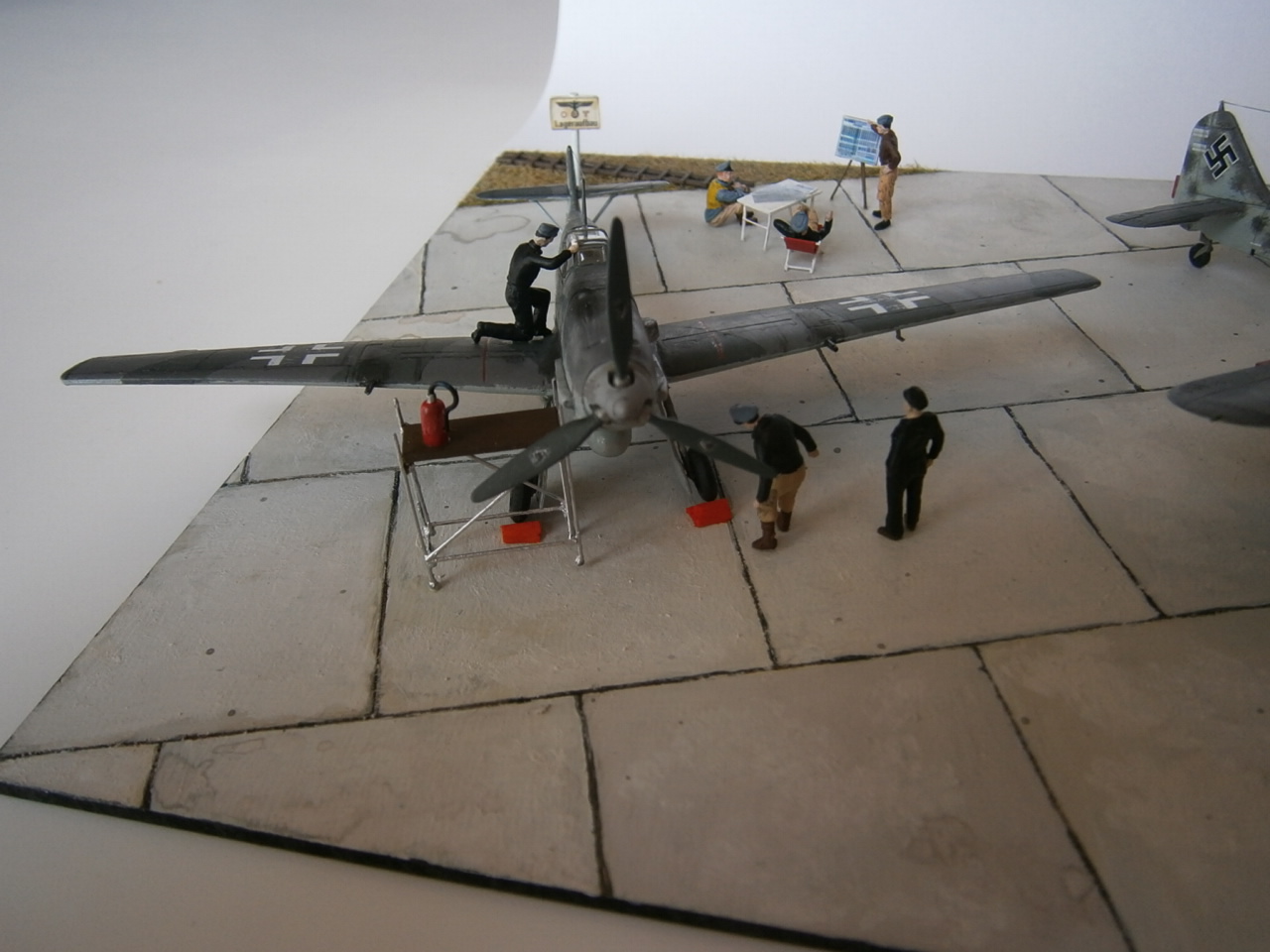
Wilde Sau - Fw 190A6 of Stab/JG300 flown by Hauptmann F-K Müller and Bf 109T-2


Wilde Sau as well as Jagdgeschwader 300, 301 and 302 came into fruition after an initiative by Oberst HaJo Herrmann, a former bomber pilot. Single-seat fighters were to climb above RAF bombers and thus find the bombers silhouetted against clouds illuminated by searchlights or the burning targets on the ground. JG 300 was the first unit to be organized, and there were initially some difficulties finding aircraft. Pilots were authorized to borrow day fighters, and there are indications that JG 300 took over some of the Bf 109 T-2 that were initially produced for use on the planned aircraft carrier Graf Zeppelin.

Friedrich-Karl Müller — "Nasen-Müller" — (4 December 1912 – 2 November 1987) was one of the most successful night fighter aces.  In the summer of 1943, Müller was invited to join Hajo Hermann and implement the latters Wilde Sau tactics. Hermann considered Müller an ideal candidate for the role because of his blind flying instructing experience. He was appointed Technischer Offizier of JG 300 on its inception in June 1943. On the night of 3/4 July, Müller recorded his first Wilde Sau victory. At the end of November 1943, Müller was appointed Staffelkapitän of 1./JG 300. He had 19 victories to his credit at this time, eventually ending - and surviving - the war with 30 night victories during 52 missions.

The models are the Academy Fw 190 and the RPM Bf 109 T-2. These were perhaps not the ideal choices, with the Fw 190 suffering from some inaccuracies in the cockpit area and with the detail on the Bf 109 being quite soft. Nevertheless, they were easy to assemble and the with some paint and decals they look the part. Astute observers will notice that the Fw 190 is lacking its head rest, and that is intentional: Müller removed the head rest to improve cockpit visibility. The aircraft are definitely parked precariously close to each other, but artistic license will have to explain that. The figures are from Revell, and the vehicles from Fujimi, while the various pieces of furniture are scratch built. Hopefully you can imagine HaJo Herrmann reclining in his red beach chair while "Nasen-Müller" elaborates on tactics and technology at the blackboard.

 "Nasen-Müller"

Monday, September 3, 2012

Hawker Hurricane Mk I flown by Mirosław Ferić


 Mirosław Ferić

The Airfix Hurricane MkI is one of the few models available of the true champion of the Battle of Britain. It does feature raised panel lines and some minor fitting issues, especially when joining the aircraft body to the wings. But taping up the wings to eliminate the gaps and to achieve the correct dihedral solved that. I also added a floor to the cockpit, a gun sight, a late model radio mast, pitot tube, clear plastic position and navigation lights and the auxiliary gun sight as well as the rearview mirror. The decals came from Techmod, and this model represents a Hurricane flown by Miroslaw Feric, a Polish pilot (his father was Croatian, hence the name). He started out his career in a P.11c during the German invasion of Poland in 1939, and his diary formed the basis of the unit history of No. 303 (Polish) Squadron of the RAF. He flew with the Poles that opted to fly for the French before evacuating to England. He was to become the eleventh ranked Polish ace with eight and 2/3 kills and one probable before being killed when his Spitfire broke up above Northolt at an altitude of 3,000 feet in January 1942.

Airfix SPAD VII - a kit from 1959.


The Airfix model of the classic SPAD VII has been around for a good 53 years, although this boxing is from the 1980s or early 1990s. The "cheese grater" wings are, of course, a problem, but I tried to minimize contrast in the ribbing instead of filing down everything, including other detailing. I added rigging, and although I originally wanted to make a SPAD of the Franco-American "Escadrille Lafayette", the decals refused to cooperate, so it became a Black 8 from "Les Cicognes", including a pilot making a rude gesture to an an unseen colleague. It did not make sense to me to super-detail a cockpit in an aircraft that was lacking in detailing on many levels, so that is why the pilot was added. Nevertheless, this was a fun build. The base is an old room key from a hotel in Florida that was covered with static grass and paint.