Monday, December 10, 2012

U-826


The U-826 was ordered on June 8, 1942, laid down on August 6, 1943, and launched in Danzig on March 9, 1944. It was commissioned on May 11, 1944, and commanded by Oberleutnant zur See Olaf Lübcke. The U-boat was part of the 8. Flottile, a training unit, between May 11, 1944, and December 31 that same year, after which it was attached to the 11. Flottille as a front boat. U-826 conducted one four-day training criose between Kiel and Horten before sailing on its one and only war patrol that lasted for 64 days between March 9 and May 11, 1945, when the U-826 surrendered to the Royal Navy. Lübcke did not sink any ships, but he and his crew survived the war. It seems reasonable to assume that the Schnorkel may have helped them. The kit is the Mirage Type VII with snorkel, and the Mirage photo-etch was added to the kit.

 Oberleutnant zur See Olaf Lübcke

Polikarpov I-16


The ubiquitous Polikarpov I-16 was usually seen in green livery, but some were painted in AEh-9 light gray with black AEh-11 cowlings during the pre-war period. The spinners were usually painted white, although there were cases of spinners being painted black as well. A scratch-built camera has been added to the underside of the starboard wing, and such fast reconnaissance versions of the I-16 type 10, 18, 24 and 28 were used during the early phases of the war on the Eastern Front. Such aircraft did retain their armament of four ShKAS 7.62mm machine guns, and the latter types may have retained their cannon armament.

The kit is the Hasegawa I-16 type 18, which is an easy build. The figures, decals and oil drum is from the spares box, and since this is supposed to be a reconnaissance aircraft assigned to a higher headquarters, it is mounted on a concrete tarmac instead of a grass airstrip. 

Saturday, November 24, 2012

The tale of a man who thought he was Göring's nephew.

USAAF Captain Werner Goering piloted a B-17 over Germany in 1944 and 1945 with the 303rd Bomb Group of the 8th Air Force, firmly believing that he was the nephew of Hermann Göring, the infamous German Reichsmarschall and commander of the Luftwaffe. Not only was Captain Goering certain he was Hermann's nephew, but so was the FBI. This led to the FBI assigning Captain Goering's co-pilot, First Lieutenant Jack Rencher, with the task of killing Captain Goering if he was forced to crash-land in occupied Europe or if he would desert to the German side. Goering was not at any cost enable the Nazis to stage a propaganda coup.

Werner Goering was born in Salt Lake City, Utah, in 1923. His parents had been converted by Mormon missionaries in Germany and convinced to move to Salt Lake after the First World War. Werner Goering volunteered for service in 1941, but his career was halted due to his supposed relation to Hermann Göring. He was eventually allowed to deploy overseas, but only with Jack Rencher as his co-pilot. Goering and Rencher were quite friendly, but their friendship was tested to the extreme when they nearly were shot down on November 21, 1944, during a mission to the Leuna chemical complex in eastern Germany. Their B-17, Teddy’s Rough Riders, was hit by flak fire, knocking out two engines gone and numerous holes in the aircraft. As the aircraft slowly limped home. Rencher waited for Werner to give the command to bail out; once he did, Rencher would have to assassinate Werner and take control of the aircraft. At the last possible moment, the men spotted the English Channel, and they returned safely.

As it were, Goering was actually not related at all to his German namesake. Werner's father had simply used Hermann's name to impress his neighbors of the German community in Salt Lake City. Werner Goering lived with this myth until fairly recently, when author Stephen Frater wrote about this odd story.

Rencher to the left, Goering to the right.

Monday, November 19, 2012

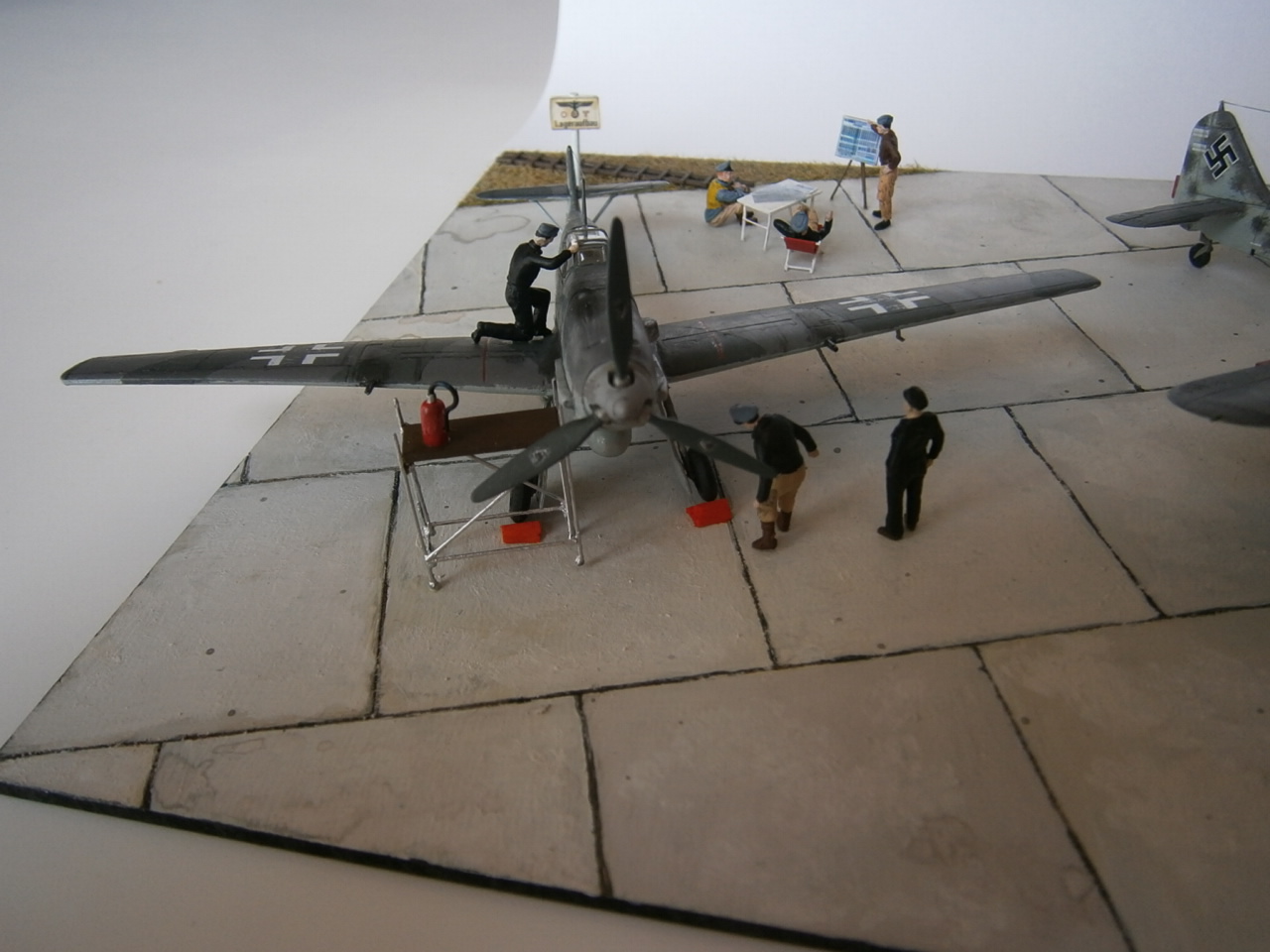
Wilde Sau - Fw 190A6 of Stab/JG300 flown by Hauptmann F-K Müller and Bf 109T-2


Wilde Sau as well as Jagdgeschwader 300, 301 and 302 came into fruition after an initiative by Oberst HaJo Herrmann, a former bomber pilot. Single-seat fighters were to climb above RAF bombers and thus find the bombers silhouetted against clouds illuminated by searchlights or the burning targets on the ground. JG 300 was the first unit to be organized, and there were initially some difficulties finding aircraft. Pilots were authorized to borrow day fighters, and there are indications that JG 300 took over some of the Bf 109 T-2 that were initially produced for use on the planned aircraft carrier Graf Zeppelin.

Friedrich-Karl Müller — "Nasen-Müller" — (4 December 1912 – 2 November 1987) was one of the most successful night fighter aces.  In the summer of 1943, Müller was invited to join Hajo Hermann and implement the latters Wilde Sau tactics. Hermann considered Müller an ideal candidate for the role because of his blind flying instructing experience. He was appointed Technischer Offizier of JG 300 on its inception in June 1943. On the night of 3/4 July, Müller recorded his first Wilde Sau victory. At the end of November 1943, Müller was appointed Staffelkapitän of 1./JG 300. He had 19 victories to his credit at this time, eventually ending - and surviving - the war with 30 night victories during 52 missions.

The models are the Academy Fw 190 and the RPM Bf 109 T-2. These were perhaps not the ideal choices, with the Fw 190 suffering from some inaccuracies in the cockpit area and with the detail on the Bf 109 being quite soft. Nevertheless, they were easy to assemble and the with some paint and decals they look the part. Astute observers will notice that the Fw 190 is lacking its head rest, and that is intentional: Müller removed the head rest to improve cockpit visibility. The aircraft are definitely parked precariously close to each other, but artistic license will have to explain that. The figures are from Revell, and the vehicles from Fujimi, while the various pieces of furniture are scratch built. Hopefully you can imagine HaJo Herrmann reclining in his red beach chair while "Nasen-Müller" elaborates on tactics and technology at the blackboard.

 "Nasen-Müller"