Saturday, June 22, 2013

Polikarpov I-16 type 4

This little Rata was built several years ago. It is the A-Model version of the Polikarpov I-16 type 4, and it was quite difficult to assemble. The kit had very well defined engraved panel lines, but that was the most redeeming feature. It is supposed to be one of the more accurate I-16s around, but I would not have a go at it again. The Hasegawa kit is so much simpler to assemble, although it is claimed that it is not as accurate a representation.

The I-16 is finished in colors typical of the VVS in mid-1941, and the unit markings are fictional.


Wednesday, June 19, 2013

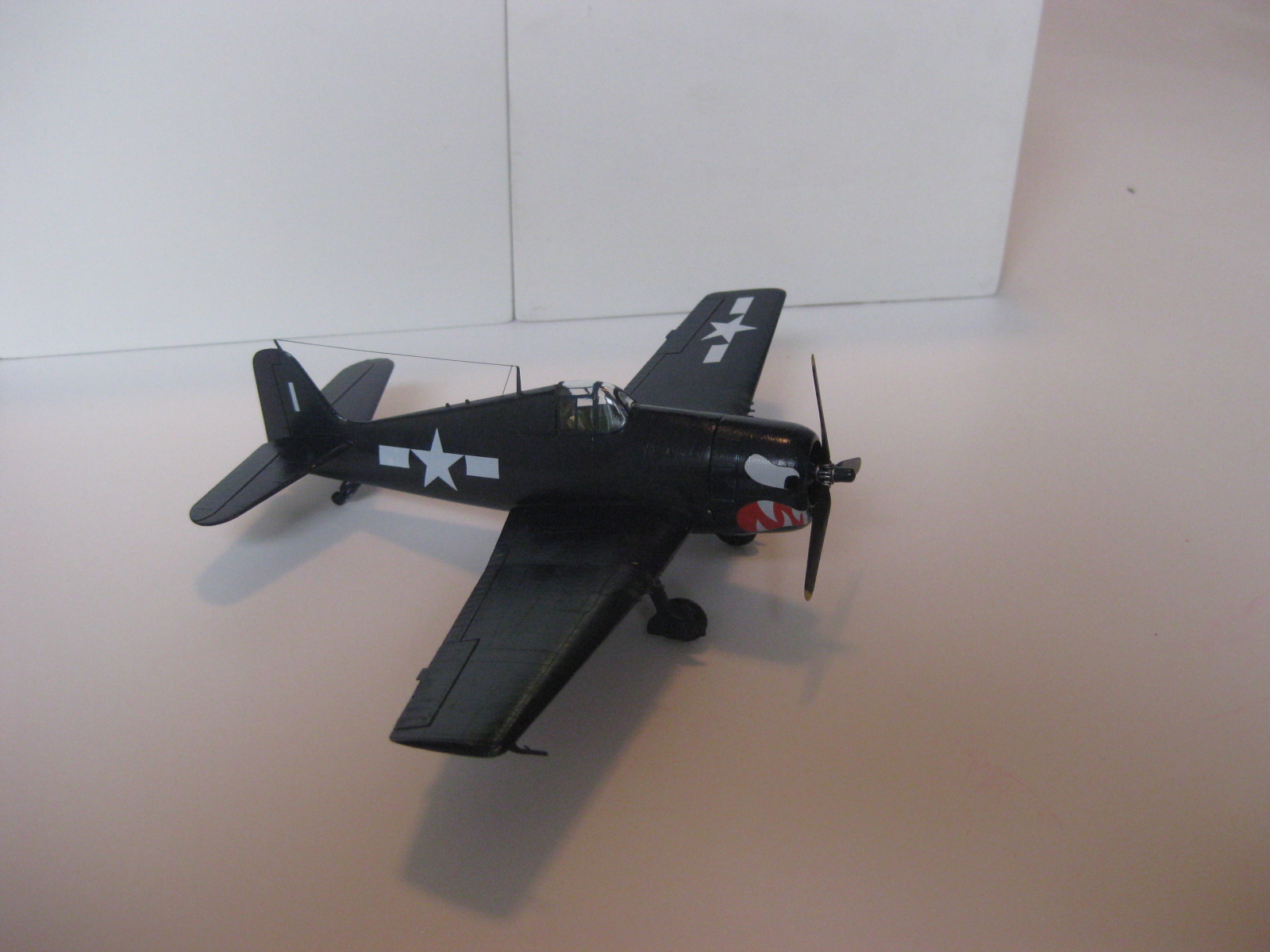
The Beast from Beth Page: Grumman F6F-5, VF-27, USS Princeton (CVL-23, 1944)

The Grumman Hellcat had the most favorable kill ratio of any allied fighter of WW2. It also helped that both the Japanese Army and the Navy had deplorable training standards by the end of the war. The Hellcat was indeed a beast, weighing in at 12,598 lb (5,714 kg) and with a wingspan of 42 feet and 10 inches (13.06 m). It had a maximum speed of 380 mph (610 km/h) and a range of 945 miles (1,520 km). The Hellcat was armed with six .50 caliber machine guns and it could carry both bombs and rockets in various combinations or even a torpedo. All Hellcats were built at Grumman's Beth Page plant on Long Island.

VF-27, the squadron that this aircraft belonged to, was activated at NAS Norfolk in April 1942 with the designation VGF-27 and equipped with Wildcats. The unit first saw action over French Morocco during Operation Torch and it remained aboard USS Suwannee for eight months. VGF-27 was re-designated VF-27 in March 1943 and deployed to Guadalcanal. The unit was refitted with Hellcats in the United States in early 1944 before embarking on USS Princeton. The cat's mouth markings were applied while stationed at Kahului NAS on Maui, mainly by the squadron artist, Robert Burnell.

June saw VF-27 flying missions against both Saipan and Tinian, and it participated in the "Great Marianas Turkey Shoot" on June 19th. On September 21, VF-27 flew a fighter sweep over Manila, claiming 38 IJN and IJAAF aircraft in the process. Formosa was also attacked before the Princeton returned to the Leyte Gulf as apart of Task Force 38.3. On October 24. VF-27 claimed 36 enemy aircraft, and four VF-27 pilots became "aces in a day", but Princeton had been hit at 0938 that same morning. A single bomb exploded in the midst of the Grumman TBF Avengers that were armed on the hanger deck. There were several explosions, and she could not be saved due to the heavy fires on board. The USS Princeton was sunk by US torpedoes seven hours later. This was the end of VF-27s war cruise, and as the Hellcats landed on other carriers, some navy commanders had opinions about the cat's mouth insignia, and they were promptly painted over. The unit had claimed 136 victories, out of which 104 were claimed on three days.

VF-27 was eventually reformed on USS Independence and one more victory was claimed before the war ended. The unit was disbanded on November 26, 1945. Ten pilots became aces and seven were lost.

The model is built out of the Hobbyboss Easy Assembly kit. I did get a couple of the easy assembly kits to entertain my daughter, who has decorated her room with some very colorful re-interpretations of both old and modern aircraft as well as a pink and yellow Typhoon class SSBN. It is, however, nice to share a hobby and it provides lots of quality time accompanied by good music. The Hellcat kit sported a good fit, excluding the canopy, with nice engraved panel lines. The livery is - obviously - insignia blue all over, although the nose art decals were a bit difficult to get to settle properly. I added seat belts to the cockpit and a radio antenna. Considering the cost of the kit, it was adequate, although I may want to try building the much-praised Eduard Hellcat kit at some point in the future for a more accurate model.




Thursday, May 23, 2013

Saab J35D Draken


The SAAB J35 Draken entered service in 1960 and served within the Swedish Air Force until 1998. It also served with the Austrian, Danish, and Finnish Air Forces. The J35 was intended as a high-altitude interceptor, but it performed quite well at lower altitudes as well. The characteristic double-delta wing makes the aircraft stand out to this day. The name "Draken" meand both dragon and kite, although some of the engineers working on developing the aircraft in the 1950s claim that the name refers to the airframe's similarity to a kite, and not the fire-breathing monster.

The kit is the Airfix J35F, originally marketed in 1970. The kit has several errors, such as the exhaust, the intakes, the pitot tube and some other minor issues, but it is easy to assemble and definitely looks the part of a J35, however with the early style canopy and the two cannon (one in each wing) the Airfix kit is more akin to a J35D, and hence I removed the IR sensor under the nose and the inlets on the spine to make a J35D. This version was the fastest of the J35 versions, being equipped with a Rolls Royce Avon 300 (RM 6C) which could deliver 77.3 kN of thrust with the afterburner turned on, making it able to accelerate until out of fuel. It was also the last J35 to carry two cannon. The D version was introduced in 1964.

Back to the kit: I decided to paint it in silver, a style typical of early Draken interceptors. I omitted the Rb27 and Rb38 missiles, which were the Swedish designations for the Hughes Falcon AAM, but added fuel tanks from the Revell Draken kit.


Although not immediately obvious in the photo, these particular J35s have one of their fuel tanks painted both green and grey. If this is to differentiate the left tank from the right tank or just to try out different paints is unknown to me. Please do let me know if you have an explanation.

Besides national and tactical markings, I added the unit insignia from the F13 Fighter Wing in Norrköping with the crest of the city depicting the patron saint, Saint Olaf, and a red eagle. The motto reads "Altius Citius Pericula Commoda Suscipientes", or "higher and faster with risks worth taking". However, this emblem was introduced in 1968, when I believe that most J35s had been painted in a green/grey camouflage pattern, so I will have to claim artistic license for the addition of the unit insignia. The aircraft is mounted on a CD painted to look like one of the roadway bases used by the Swedish Air Force during the Cold War. A no-parking sign was added for the sake of levity.

Also, please enjoy the clip above, which is from 1968 featuring a young Agnetha Fältskog of ABBA fame singing the praise of the J35!