Thursday, May 23, 2013

Saab J35D Draken


The SAAB J35 Draken entered service in 1960 and served within the Swedish Air Force until 1998. It also served with the Austrian, Danish, and Finnish Air Forces. The J35 was intended as a high-altitude interceptor, but it performed quite well at lower altitudes as well. The characteristic double-delta wing makes the aircraft stand out to this day. The name "Draken" meand both dragon and kite, although some of the engineers working on developing the aircraft in the 1950s claim that the name refers to the airframe's similarity to a kite, and not the fire-breathing monster.

The kit is the Airfix J35F, originally marketed in 1970. The kit has several errors, such as the exhaust, the intakes, the pitot tube and some other minor issues, but it is easy to assemble and definitely looks the part of a J35, however with the early style canopy and the two cannon (one in each wing) the Airfix kit is more akin to a J35D, and hence I removed the IR sensor under the nose and the inlets on the spine to make a J35D. This version was the fastest of the J35 versions, being equipped with a Rolls Royce Avon 300 (RM 6C) which could deliver 77.3 kN of thrust with the afterburner turned on, making it able to accelerate until out of fuel. It was also the last J35 to carry two cannon. The D version was introduced in 1964.

Back to the kit: I decided to paint it in silver, a style typical of early Draken interceptors. I omitted the Rb27 and Rb38 missiles, which were the Swedish designations for the Hughes Falcon AAM, but added fuel tanks from the Revell Draken kit.


Although not immediately obvious in the photo, these particular J35s have one of their fuel tanks painted both green and grey. If this is to differentiate the left tank from the right tank or just to try out different paints is unknown to me. Please do let me know if you have an explanation.

Besides national and tactical markings, I added the unit insignia from the F13 Fighter Wing in Norrköping with the crest of the city depicting the patron saint, Saint Olaf, and a red eagle. The motto reads "Altius Citius Pericula Commoda Suscipientes", or "higher and faster with risks worth taking". However, this emblem was introduced in 1968, when I believe that most J35s had been painted in a green/grey camouflage pattern, so I will have to claim artistic license for the addition of the unit insignia. The aircraft is mounted on a CD painted to look like one of the roadway bases used by the Swedish Air Force during the Cold War. A no-parking sign was added for the sake of levity.

Also, please enjoy the clip above, which is from 1968 featuring a young Agnetha Fältskog of ABBA fame singing the praise of the J35!


Saturday, March 30, 2013

F-86A Sabre, 4th Fighter Interceptor Wing, Kimpo AFB, South Korea, June 1951

This Matchbox kit is, to the best of my knowledge, the only one of a F-86A that can be found. It is basic, but comes together well. The decals are a bit thick, as Matchbox decals tend to be, but since I wanted to build this kit out-of-the-box, I used the markings that were provided. The aircraft is obviously mounted on the little stand that comes with the kit, and the reason for this is twofold: the landing gear was very basic, and since the kit doesn't come with drop tanks, it looked rather attractive as a clean F-86, all fresh and gleaming.

The 4th Fighter Group ("The MIG Killers") was formed on September 12, 1942, and it included the American pilots of the Royal Air Force Eagle Squadrons. It was re-formed in 1947 as apart of the Strategic Air Command, and it was the first unit to deploy Sabres in Japan in November 1950 after it was clear that the Chinese had committed MiG-15s against the UN forces in Korea. The 4th FIW was composed of the 334th, 335th and 336th squadrons and also the Royal Australian Air Force No. 77 Squadron. The 4th claimed 502 enemy aircraft during the Korean War, with 24 pilots becoming aces. The 4th FIW was the top-scoring fighter unit in the Korean War.
 
The pilots of the 4th Fighter Interceptor Wing included well-known aviators such as aces Colonel Frances Gabreski and Major James Jabara, the first jet ace. Future astronaut John Glenn flew his second tour with the 4th FIW as part of an interservice exchange program.


http://www.finesthourart.com/shop/totherescue.jpg

Sunday, February 10, 2013

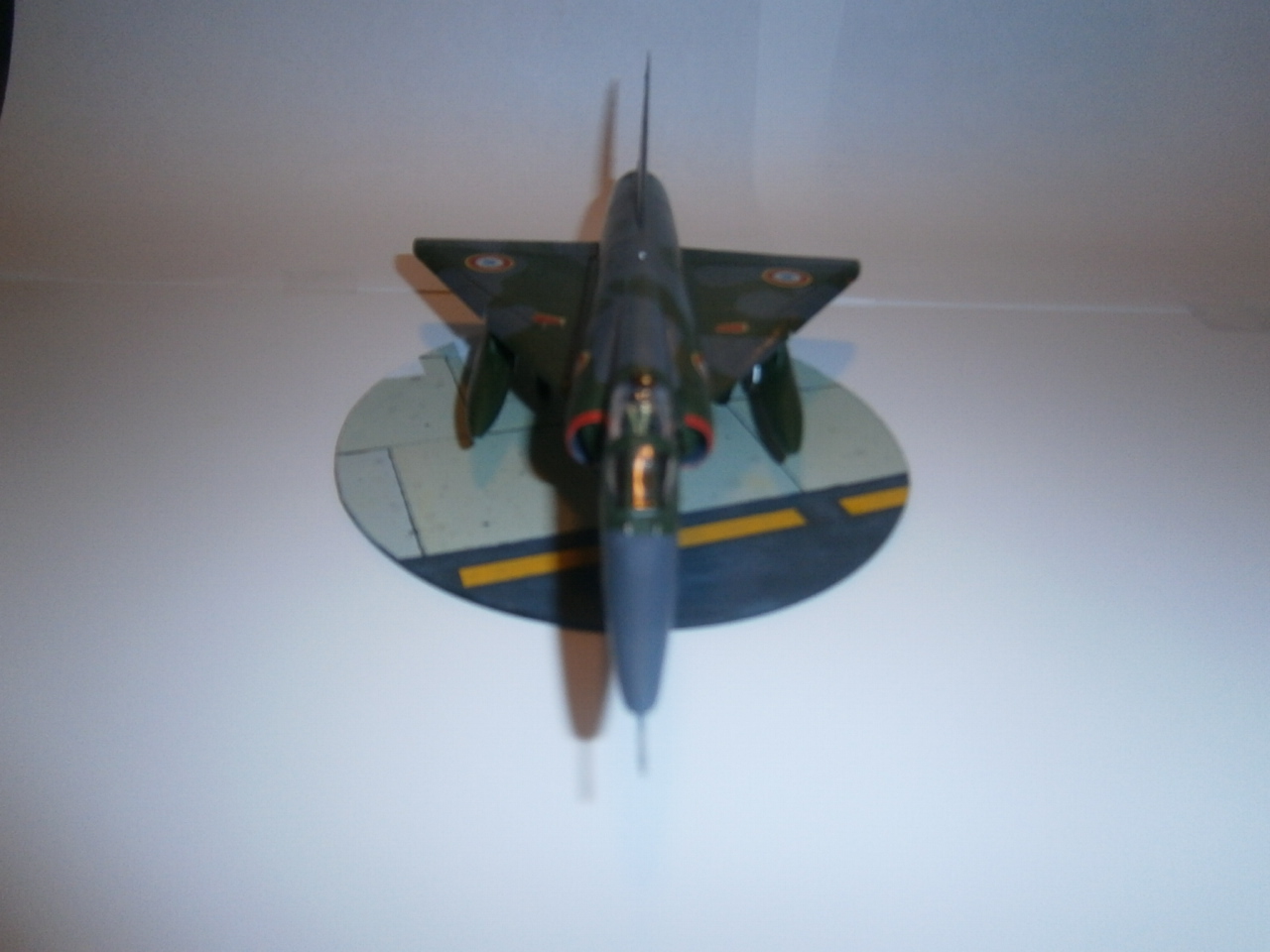
Dassault Mirage IIIR from ER 3/33 'Moselle', Strasbourg-Entzheim, early 1970s.

The iconic French Mirage fighter came in many versions, including this reconnaissance version that replaced the RF-84F Thunderflash in French service. It was also used by Abu Dhabi, South Africa, Pakistan and Switzerland.

The navigational calculator of the IIIR was not up to par, and a modernized version was designed to be fitted with systems from the Mirage IIIE. ER 3/33 'Moselle' was the only unit to use this modernized version of the IIIR, the Mirage IIIRD, this version having the same Doppler effect Cyrano radar as the IIIE (the designation 'D' was for Doppler). The 'Moselle' squadron received these aircraft between 1967 and 1969, and they were eventually replaced in 1988. Twenty Mirage IIIRD were delivered to the Armee de l'Air, and they were in turn replaced by the Mirage F1CR.

A Mirage IIIR was used by Jacqueline Auriol to improve her closed-circuit speed record on June 14, 1963, when she completed the course at an average speed of 1,268.75 mph or 2,030 kph.

The Revell 1/72 Mirage III is from the 1970s, and it retained some of the features of an era when models were built to be toys: a canopy that could be opened, an engine that could be pulled out for examination, and wheels that could be made to roll. It is nice kit for its era, and it provides markings for Mirage IIIE, IIIS, IIIRS and IIIRD aircraft of the French and Swiss air forces, although the decals were quite disappointing. The Mirage was painted in Vallejo colors. Headlights and front antennae were added to the kit.