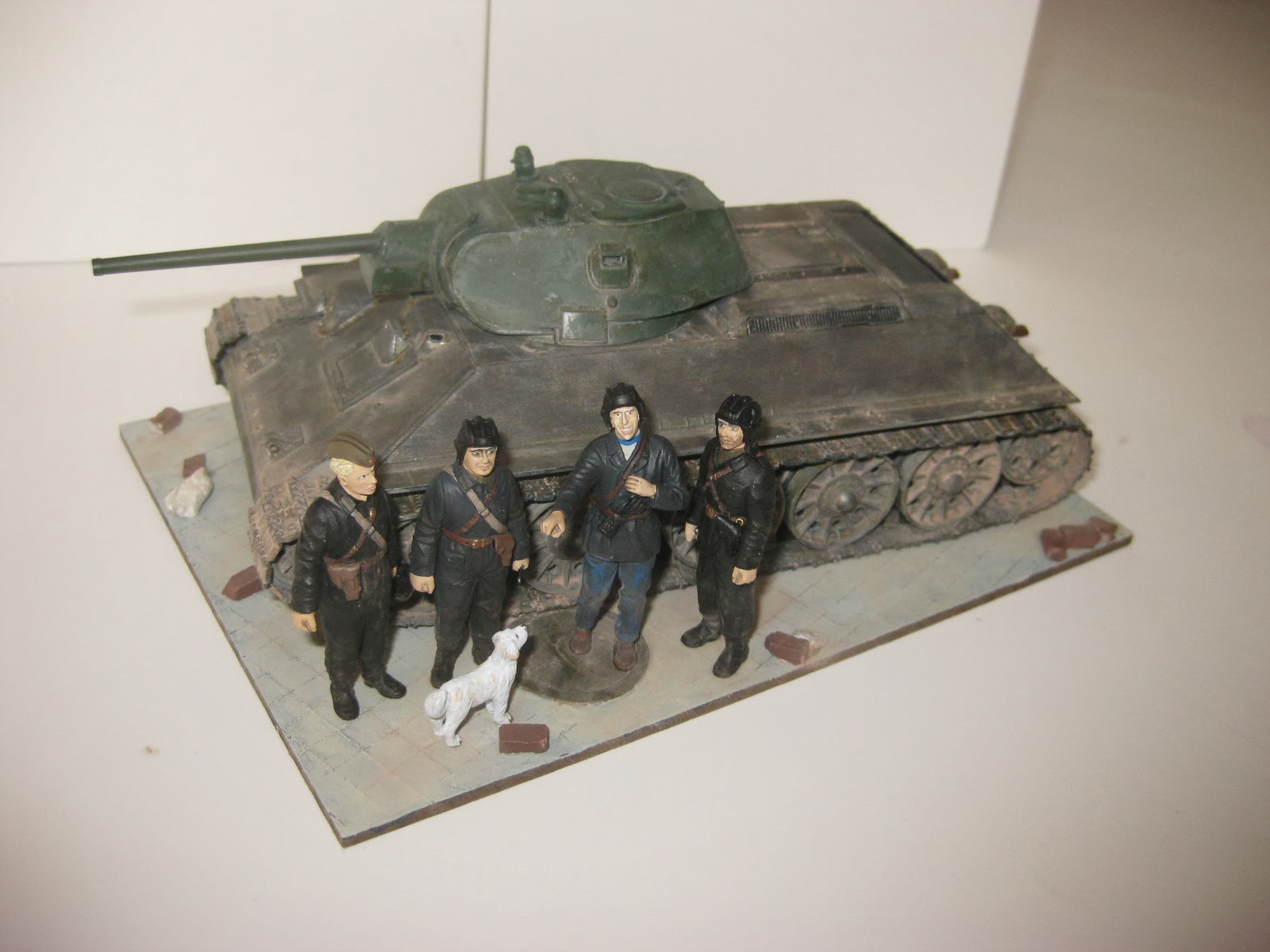
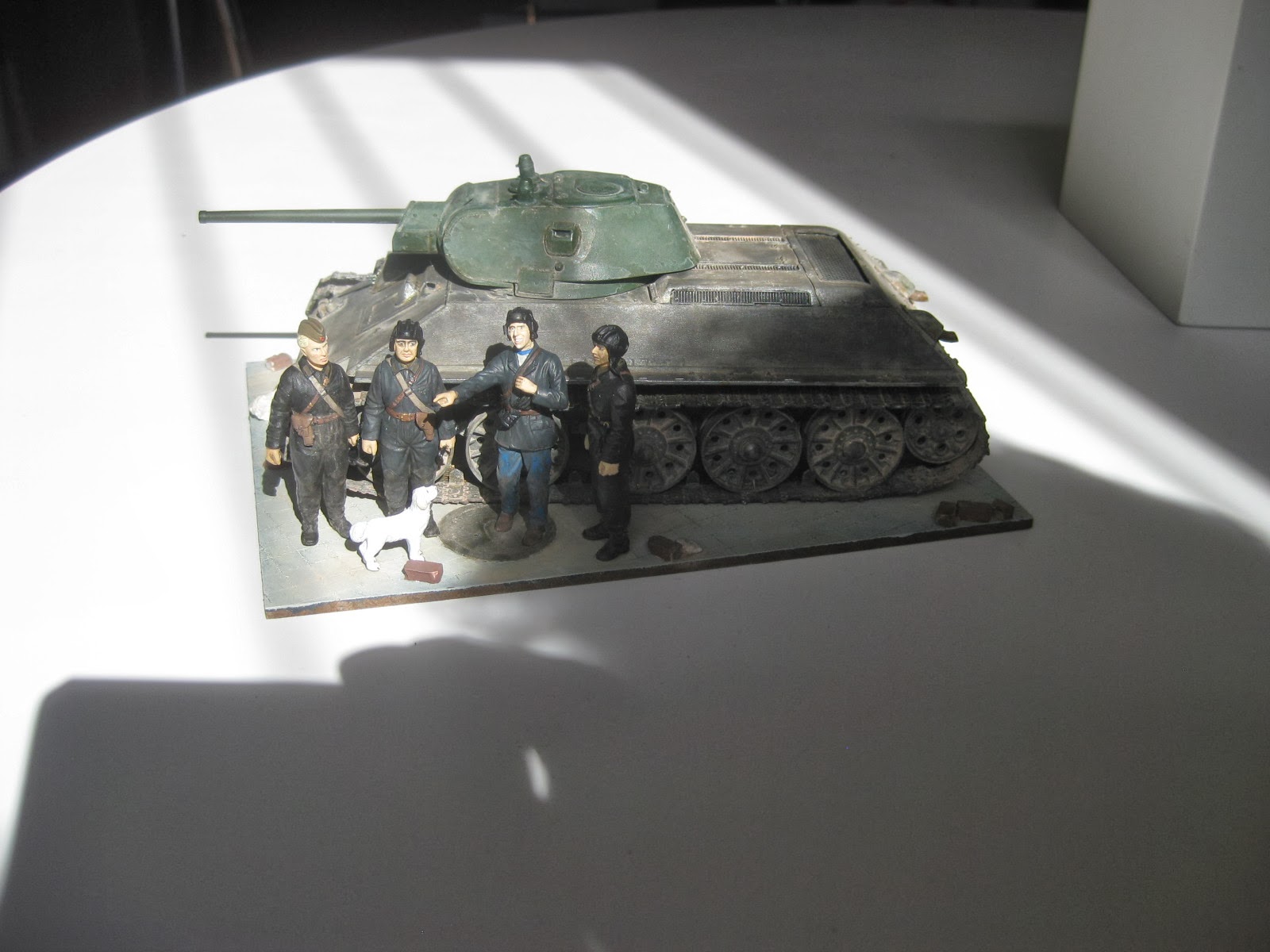
The Battle of Stalingrad was obviously one of the pivotal events of WW2, and these desperate times did call for desperate measures. The STZ, or rather the Stalingrad Tractor Factory named after Feliks Dzerzhinsky (Сталинградский тракторный завод им. Ф. Э. Дзержинского) was designed by an American architect, Albert Kahn, and it opened in 1930. It was also to become one of the pivotal locations during the Battle of Stalingrad.
The T-34 tank was initially manufactured in Charkov, but with the tank showing much promise, the manufacture was expanded to the STZ plant with assistance from Factory No. 264, the Stalingrad Barge Works,
and Factory No. 221, the "Barrikady" artillery foundry. Another plant to manufacture T-34 tanks was Factory No. 112, "Krasnoye Sormovo." The first tanks was manufactured in early 1941, and over time some unique design features appeared in the STZ T-34, most notably the perforated metal road wheels, "chisel" mantlet, and other details. Although production was halted during the height of the battle, by early 1943, some 3,770 T-34 tanks had been produced by the STZ plant.
There are persistent anecdotal recollections of tanks being driven out directly from the STZ production lines into combat. These would have been unpainted or only covered by iron oxide primer, lacking sights and other accessories, and manned by factory workers of both genders. This is featured in Anthony Beevor's "Stalingrad" as well as many other sources, although these stories are emphatically denied by armor expert Cookie Sewell. The photo below is claimed to be of a knocked out in Stalingrad, and it is definitely lacking fenders, headlights and other details, although the photo doesn't answer the question whether it is painted or not.
For the sake of experimentation, let us assume that the STZ produced and repaired tanks with or without paint until he last possible minute. The T-34 model below
represents a mix of components. The kit is based on a Dragon T-34 model
41, and it is fitted with STZ road wheels, although not a STZ turret. Perhaps the hard-working laborers of the STZ plant married a working turret from a less hastily produced T-34 model 41 (B 2/11 would stand for bashnya/turret two of eleven) to a STZ chassis sans accessories, thus producing this beauty? The figures are a mix of DML, ICM and Verlinden, with a Trumpeter animal friend. The commander may very well be a factory worker, since he is wearing civilian clothing and a tanker's helmet. Now let's roll out and beat the Fascist invaders, shall we?
Wednesday, February 26, 2014
Friday, January 24, 2014
Dassault Super Mystère
The Dassault Super Mystère was first flown on March 2, 1953, has the distinction of being the first European aircraft to break the sound barrier. It was similar to the North American F-100 Super Sabre, the Soviet MiG-19 and somewhat similar to the SAAB J-32 Lansen. The Super Mystère served with the air forces of France, Israel and Honduras, being retired from the Armee de l'Air in 1977.
It served in the Israeli Air Force (IAF) as the Sambad (a Hebrew acronym of "Super Mystère B Deux") from 1959 and it acquitted itself well against MiG-17 and MiG-19s, although the engine was found to be weak. Initial dogfights in the early 1960s did not result in any enemy aircraft shot down despite some excellent opportunities. It turned out that the 30mm DEFA cannons rounds were set for delayed detonation, which was ideal for bringing down Soviet bombers, but not jet fighters. As the Dassault Mirage entered IAF service, the Super Mystère began flying ground attack missions, and the IAF Super Mystères were heavily engaged in the 1967 war. 507 sorties were flown during the war and nine Super Mystères were lost, while five enemy aircraft were shot down. The Super Mystère pilots did encounter MiG-21s during the war, but despite being outperformed, the IAF pilots managed to evade the MiG-21s and on at least one occasion shoot down two Egyptian MiG-21s. The IAF Super Mystères were upgraded in 1969 with stronger engines to the Sa'ar (Tempest), and it served into the 1970s. The air force of Honduras operated Super Mystères between 1976 and 1996.
The model is the Airfix Super Mystère from the early 1970s, and it is one of the better Airfix kits of the era. The raised panel lines are discreet, and the cockpit has a reasonable amount of detailing. The fit was quite good, with the exception of the cockpit, and the decals were in good shape, although the blue had faded. The markings are of an aircraft belonging to the EC 2/10 'Seine' squadron in the mid-1960s, which had two escadrilles, the Cercle de Chasse de Paris, which was founded in 1934, and SPA 76, which originated from 1916, although it was disbanded between 1919 and 1938. During the Second World War the escadrilles formed the fighter squadron GC III/10. The Super Mystère was in use between 1959 and 1968, after which the squadron flew the Mirage IIIC until 1985, when the squadron was disbanded.
Labels:
1/72,
Airfix,
armee de l'air,
dassault,
EC 2/10,
IAF,
Israeli Air Force,
Seine Squadron,
Super Mystère
Subscribe to:
Posts (Atom)